










National Youth Day 2026: Transforming Rural Leadership — Stories Of Courage & Change |
Indore (Madhya Pradesh): India’s youth – 378 million strong – represent the pulse of the nation’s future. But despite making up nearly two-thirds of the population, rural youth remain on the sidelines of India’s economic growth. Contributing just 46% to the national GDP, the vast majority still depend on agriculture and face mounting challenges. For women, the obstacles are even more daunting. According to Transform Rural India’s (TRI) State of Rural Youth Employment 2024 report, a large portion of rural youth – especially young women – remain excluded from opportunities for growth, held back by societal barriers and systemic inequalities.
Yet, even in the most underserved corners of the country, a new wave of leadership is rising. But not the kind that’s defined by titles or authority. It’s the kind of leadership that emerges from everyday action, driven by determination, empathy, and the courage to challenge the status quo. This National Youth Day, we celebrate three young women – Sarita Bhuriya, Nirmala, and Reshma Ninama – whose stories are rewriting the rulebook on what it means to lead in rural India.
Sarita Bhuriya: “I never saw myself as a leader, but now I am one”
In Bhagsur, Madhya Pradesh, Sarita Bhuriya spent her early years working on the farm and taking care of household chores. “At 23, I didn’t think I could ever be a leader,” she remembers. “My life was limited to the fields and home.” But everything changed when Sarita joined a Self Help Group (SHG) to learn about village processes and government schemes. It was here that she discovered a new world of possibilities.
Sarita took part in visioning exercises led by Transform Rural India (TRI), where she learned to see herself as an active member of her community. “I realized I could be more than just a worker—I could influence the decisions that affected us,” Sarita says. She trained as a Change Vector in local governance and education, and later became a Business Correspondent Sakhi, helping people access banking services.
Sarita Bhuriya | FP Photo
When the pandemic struck, Sarita led awareness campaigns about vaccinations and conducted surveys in her village. “I didn’t just want to help people survive; I wanted to empower them,” she says.
Today, Sarita runs a Common Service Centre (CSC) and earns about Rs 1.5 lakh annually, which has helped improve her family’s standard of living. “The best part is seeing other women in my village inspired by my journey,” she says. “They now believe they can achieve independence too.”
Nirmala: “I didn’t choose leadership; it was a matter of survival”
For 30-year-old Nirmala, leadership wasn’t a goal – it was born out of necessity. Married before she turned 18, Nirmala endured years of domestic violence while raising three children. When her husband left, she became the sole breadwinner. “I didn’t have time for dreams,” she says. “I had to work to provide for my children.”
But things changed when Nirmala joined an SHG and connected with TRI. “I participated in a gender training session, and it made me see that everything I went through wasn’t my fault – it was because of inequality,” she explains. This realization sparked a new path. Nirmala became the Coordinator of the Lok Adhikar Kendra under the National Rural Livelihood Mission (NRLM), where she worked to address issues like domestic violence, child marriage, dowry, and alcohol abuse.

NIrmala | FP Photo
“I wanted to help other women who were struggling like I did,” Nirmala says. “I wanted them to see they didn’t have to accept their fate.” She became a strong voice in her community, offering support to those seeking to break free from violence and oppression.
Today, Nirmala has secured a stable life for her children and continues to stand alongside other women, helping them reclaim their rights and dignity.
Reshma Ninama: “Leadership begins with listening and caring”
In Asaliya village, Reshma Ninama’s journey to leadership began with small acts of kindness. “I never thought I would be a leader,” Reshma says. “But I always believed in helping others – whether it was walking mothers to health centers or talking to children about nutrition.” Her simple acts of care made her a trusted figure in the village.
In 2021, Reshma participated in TRI’s visioning exercises, where she began to see her potential as a community leader. “I realized that I could do more than just help with small things,” she recalls. She trained as a Health Change Vector, working on maternal health, sanitation, and child nutrition. Over time, more women began to turn to her with concerns about their rights and dignity.
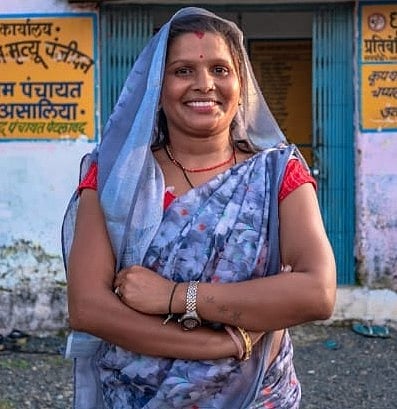
Reshma Ninama | FP Photo
“Once I started talking to women about their rights, they began to speak up,” Reshma says. “That made me want to do even more for them.” With encouragement from her community, Reshma ran for the position of Sarpanch in 2022, winning the election and becoming the village head.
As Sarpanch, Reshma prioritized health services, women’s rights, and inclusive village development. One of her proudest achievements was securing a Sub Health Centre for the village.
“Leadership is about listening to the people you serve,” she says. “When you care about your community, they will trust you, and they will follow you.”


