










Panaji: A few rooms at the Old GMC Complex here have been lined from wall to wall with Waguv mats – woven from reed and rice straw – exuding the warmth of traditional Kashmiri home, scent of the valley’s lakes, and the softness of its nature.
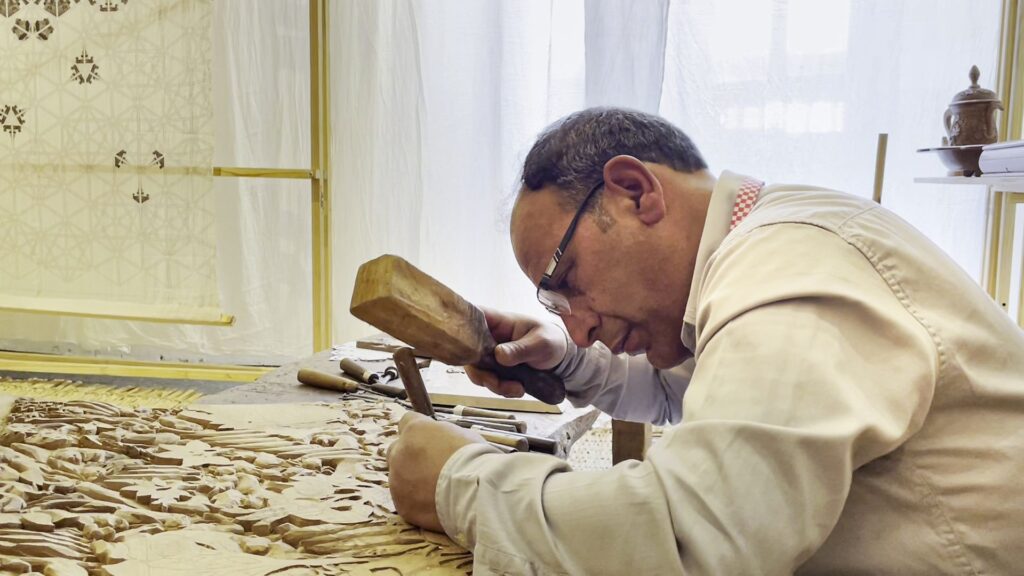
Stepping inside, one is transported to a world of handheld tools carving intricate details on walnut wood, splitting willow reeds and turning them into baskets, painting microscopic flora on papier mache boxes, and turning hard copper into jewellery and utensils.
Designer Sandeep Sangaru’s curation, titled “Hands, Tools, and the Living Thread: From Kashmiri Craft Ateliers”, at the 10th Serendipity Arts Festival celebrates the traditional crafts from the valley, featuring six artisans and one designer to showcase the art of “Traam kaam” (copper craft), “Dhung chok saaz” (walnut wood carving), “Kari Kalamdani” (painting), “Shakta saaz” (papier mache), “Namda” (hand-felted wool rug), and “Kani kaam” (willow wicker).


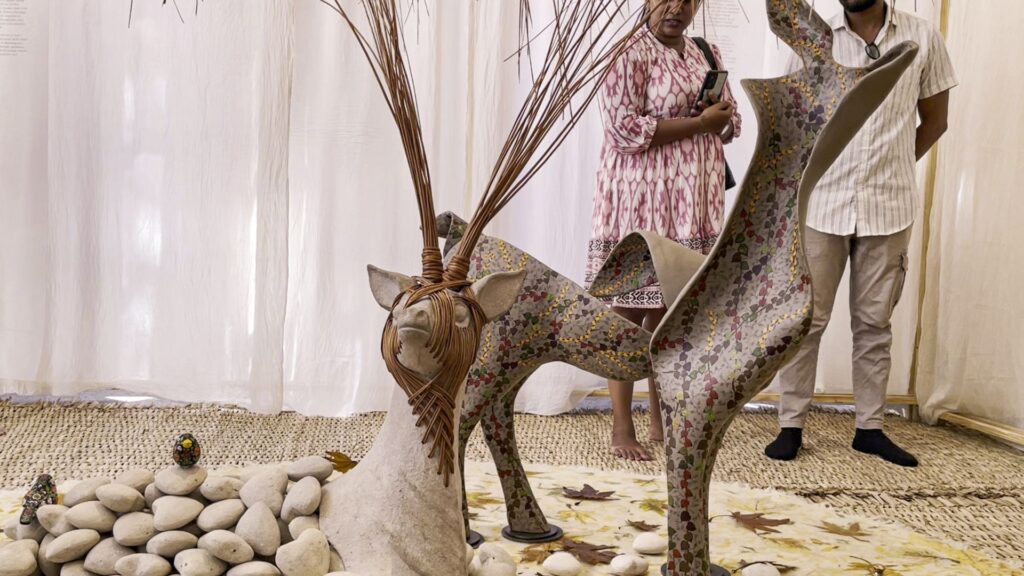
While three of the four rooms dedicated to the exhibition double up as workshops, featuring the artists showcasing their respective crafts, the fourth room brings it all together as the centrepiece of the show in an installation titled “Piknik : A Kashmiri Reverie”.
“It’s a setting of different crafts coming together, which are shown in these three rooms and that culminates into a final installation where all the crafts are talking to each other in a very interesting way. It was quite an interesting challenge which pushes the boundaries of their own skills to reimagine,” Sangaru told PTI.
A doe made of papier mache by Kausar Ahmed Shah, painted upon by Mohd Maqbool Jaan, sits on the soft namda rug by Farooq Ahmed Khan under a tree fashioned out of willow reeds by Mehraj-ud-din, as soft strains of music waft from a papier mache bluetooth speaker crafted by Burhan-ud-din.
The idea, Sangaru said, was to get the traditional craftsmen to experiment with each other in a work that is “not a collection of separate traditions but a living ecology, where each practice supports the other and where life, work and ritual flow together like a continuous current”.
At the centre of the installation, a stag rises from a mound of heart shaped pebbles – all crafted in papier mache by Shah – its horns, made of willow reed extend upward, linking it to the sweeping branches of the willow installation above.
The Piknik installation is completed by a copper samovar by Aslam Bhatt next to a picnic box in walnut wood carving by Fayad Ahmed Kalwal.
The aim with the doe, he said, was to create a presence that feels light, fragmented and fluid, yet still holds the essence of the animal.
While Burhan and Kausar shaped the majestic beast, Maqbool’s naqashi brought the work to life. The naqash’s painted ivies travel “across the surfaces like a creeper finding its way along the walls of Kashmir’s old urban houses”.
Mehraj’s work with willow wicker goes beyond its traditional usage in the installation as the supple reeds find their natural curves.
The small bluetooth speaker, almost indistinguishable from a book, came from Sangaru’s documentation of craft ateliers over the years. During his two decades of work with Kashmiri artisans, Sangaru would notice a small radio in a corner everywhere he went, wafting old Hindi songs, news bulletins and weather updates.
“For Piknik, I wanted music to drift through the installation the way it drifts through those workshops: gentle, continuous, almost ambient. Working with Burhan, who has been exploring speaker design through local materials, opened up the possibility of reinterpreting the radio in contemporary ways,” Sangaru said in a note.
The entire installation sits on a namda rug in the colours and atmosphere of “Harrud”, the Kashmiri autumn.
The valley takes a stunning bright hue in autumn, as chinar trees turn fiery red and amber and their fallen leaves carpet the land.
“Textured fibres of coloured wool are felted into the surface to evoke the soft transitions of autumn light and earth. The chinar leaves are rendered in various stages of merging with the ground, suggesting their gradual return to the soil,” the curator said.
Sangaru, who has earlier worked with artisans from the northeast and Ladakh, added that the aim behind working with Kashmiri artisans and bringing them to the Serendipity Arts Festival was also to get them exposure to other artforms.
“This is not a business platform. But here, my objective was for them to come and see the rest of the art also. For them to see what’s happening around, what people are doing. Most of the time they go to craft trade fairs where they are interacting with others on a business platform to sell their wares. Here, it’s a different opportunity for them to see that there are possibilities,” Sangaru said.
The 10th edition of the Serendipity Arts Festival opened here on December 12 with over 40 curators across disciplines of visual arts, crafts, theatre, dance, music, photography and culinary arts.
The 10-day celebration marks a decade of celebrating multi-disciplinary arts, shaped by the expertise of veterans of their respective fields, including poet-art critic Hoskote, theatre director Anuradha Kapur, Bharatanatyam dancer Geeta Chandran, music director Ranjit Barot, art curator Rahaab Allana and food historian Odette Masceranhas.
The festival ends on December 21.


