











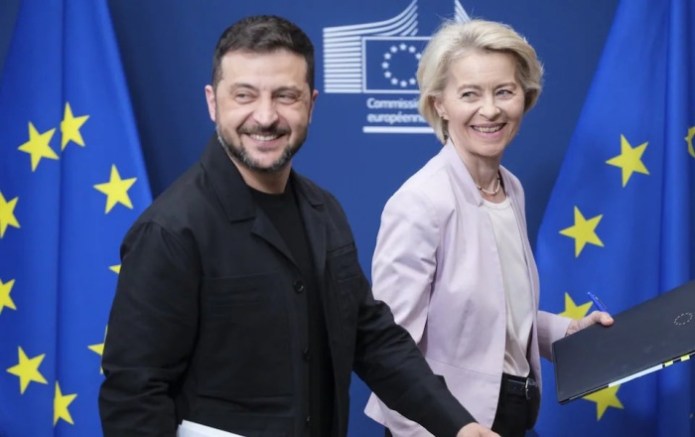
Leaders of the European Union have agreed to provide a €90 billion ($105 billion) interest-free loan to Ukraine for the year 2026-2027, to help continue its war with Russia. The agreement was finalised after marathon talks at an EU summit.
Interestingly, a controversial EU plan to use €210 billion in frozen Russian central bank assets could not materialise because there are significant legal and political hurdles against that.
No deal on using Russia’s frozen assets – the EU will instead finance Ukraine with a €90 billion loan. pic.twitter.com/C3zSg22Ucw
— Christine Mhundwa
(@mhundwa7) December 19, 2025
The loan for Ukraine will be raised through joint EU borrowing on capital markets, backed by the EU’s budget. Most importantly, Ukraine is obligated to repay only if Russia provides war reparations, effectively functioning as a grant in the absence of Moscow’s compensation.
In other words, Ukraine is not getting a “loan”, but a grant from the EU to continue fighting with Russia, and the EU will borrow money from capital markets around the world to give this grant to Ukraine.
Meanwhile, Russian assets in EU remain indefinitely ‘frozen’. The EU hopes to use them as leverage for future negotiations.
Ukrainian President Volodymyr Zelenskyy hailed the package as “significant support that truly strengthens our resilience.”
German Chancellor Friedrich Merz called it “good news for Ukraine and bad news for Russia,” while EU Council President António Costa emphasized, “We committed and we delivered.”
Why did Belgium oppose using Russian frozen assets to raise the money for Ukraine?
The initial EU plan to pay Ukraine by using the Russian assets could not materialise because of Belgium’s opposition, as per reports. Belgium cited risks of Russian retaliation and lawsuits against the Euroclear, blocking the preferred “reparations loan.”
Belgium-based Euroclear is the EU’s central securities depository. Russia has already sued it for billions of Euros, exceeding its assets value, seeking damages for the loss of interests and profits. Around 80-85% of the frozen Russian Central Bank assets are held with Euroclear, making Belgium liable for damages. Belgium wanted a guarantee from other EU nations to share the risk of damages in lawsuits, but they backed away from taking the risk.
Hungary, Slovakia, and the Czech Republic opted out of sharing the €90 billion loan burden, citing their domestic needs and economic priorities, but did not veto the agreement. Viktor Orbán opposed the plan in principle, stating that taxpayers’ money should not be used to fund Ukraine.
It is notable here that Ukraine had projected €137 billion funding gap over two years, with speculations of potential collapse by mid 2026. The €90 billion will effectively sustain Ukraine for another two years, while it battles Russia.
The EU grant to Ukraine, disguised as a loan, is effectively another affirmation of the long-standing allegation of Russia that the West, that is, the EU and USA, want to continue a prolonged war with Russia, and Ukraine is just a tool to perpetuate that goal.


