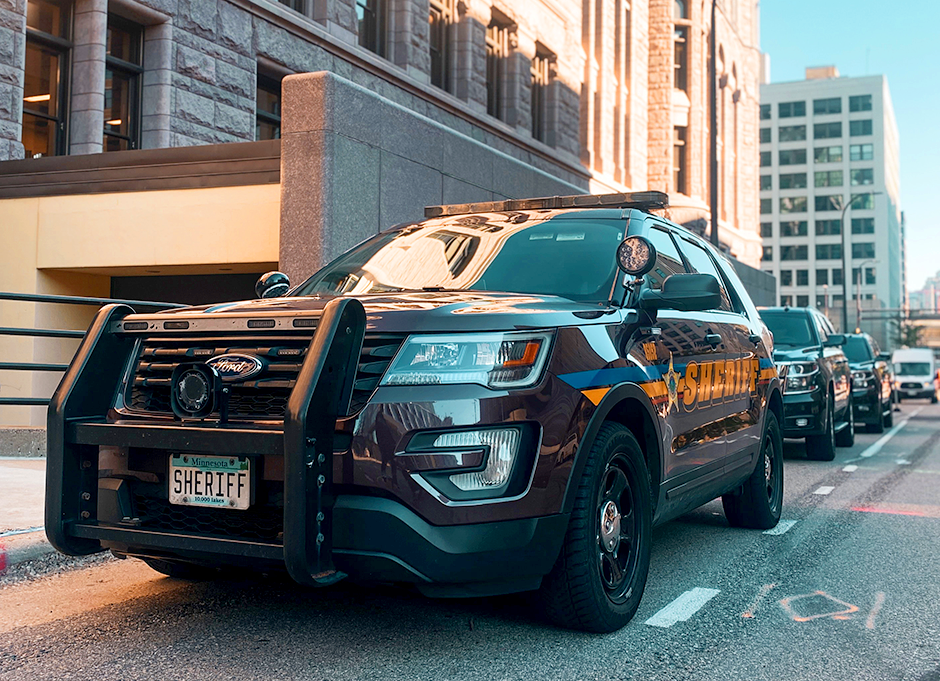
WASHINGTON – Rural Minnesota sheriffs who have contracted with Immigration and Customs Enforcement (ICE) to detain prisoners say they have been frustrated by delays for mandatory federal training, as well as pushback from immigration advocates and state officials who oppose such cooperation.
Eight Minnesota counties have agreements in place to support ICE in one way or another under what are officially known as 287(g) agreements. The federal agencies responsible for training local officers to assist with these and other federal actions have yet to schedule the required sessions, sheriffs say.
Meanwhile, the ACLU of Minnesota announced Thursday it was suing Freeborn County in southern Minnesota over its March agreement with the Trump administration to hold prisoners for ICE beyond the scheduled release date for whatever arrest or charge initially landed them in the county’s jail.
The so-called “detainer” policy allows ICE to pick up these individuals and possibly deport them. But the ACLU says Minnesota law prohibits sheriffs and other law enforcement from holding individuals for ICE after they have been released from state custody and does not authorize them to conduct civil immigration arrests.
The ACLU has forcefully opposed that policy, saying it has led to civil rights violations and deportations of people who have been detained for lesser violations, like a broken tail light.
But Minnesota’s limitations on detainers have rankled the Trump administration, prompting it to call Minnesota a “sanctuary state.”
Freeborn County Sheriff Ryan Shea said that responding to detainer requests is good police work.
“When you have someone in custody and you know another law enforcement agency wants them, it goes against the culture not to help,” Shea said. “If you have someone who’s wanted in custody, you should hang on to them for a day so ICE can pick them up.”
Like other Minnesota sheriffs who have entered into pacts with ICE or the U.S. Marshal’s Service, Shea is frustrated by delays in providing training for the 40 officers he wants to deputize to carry out their federal warrant duties.
Related: Minnesota sheriffs departments seek to cooperate with ICE
Besides Freeborn County, seven other counties — Crow Wing, Cass, Itasca, Jackson, Kandiyohi, Mille Lacs and Sherburne — have signed contracts to cooperate with ICE in one way or another under what is officially known as 287(g) agreements.
Trump won all of those counties in landslides in last November’s election, although the president failed to win the state.
But last week, Minnesota Attorney General Keith Ellison issued a legal opinion that said Minnesota law does not permit sheriffs to enter into agreements with ICE unilaterally and that the authority to enter into such pacts rests with county boards of commissioners.
Ellison’s opinion also said 287(g) agreements do not permit law enforcement agencies to detain individuals based solely on a request from ICE. Ellison said he released the opinion after receiving a request for guidance from Ramsey County Attorney John Choi.
Armed with Ellison’s legal opinion, the ACLU of Minnesota lawsuit against Freeborn County was filed on behalf of four county taxpayers.
“Under 287(g) agreements, it is the county and its taxpayers — not ICE — who are legally and economically liable for the inevitable lawsuits that follow,” the ACLU said. “Countless lawsuits have put county taxpayers on the hook to pay hundreds of thousands or even millions of dollars in liability when their sheriffs have unlawfully arrested and detained people at ICE’s request.”
‘Silly to go to the county board’
Cass County Sheriff Eric Klang said he’s holding about 60 detained immigrants in his 287-bed jail who have been apprehended in the Twin Cities area since Dec. 1, when the Operation Metro Surge was set in motion.
Besides providing ICE with bedspace that Klang wants to increase, he also signed a memorandum of understanding with the Trump administration to help ICE and the U.S. Marshal’s service in their efforts to detain and deport.
Klang criticized Ellison’s legal take on the authority of Minnesota’s sheriffs.
“It’s silly for us to go to the county board,” he said.
Yet Klang said he did not want to get into “a pissing match” with Ellison, especially since the legal opinion does not carry the weight of law. “Nothing has changed,” said Klang, who said he will continue with his plans.
Related: Why Minnesota sheriffs can’t legally hold people past their release time for an ICE detainer
The Crow Wing County Sheriff’s Department has agreed to detain for ICE undocumented immigrants when it comes in contact with them in the course of its police work. But Klang said the U.S. Marshal’s service has yet to provide the 40 hours of training required for the officers who would enforce federal immigration law.
Meanwhile, Kandiyohi County Sheriff Eric Tollefson entered into a 287(g) agreement with ICE for a warrant service officer program in May. Another agreement with ICE, known as an intergovernmental service agreement, enables the west-central Minnesota county to provide detention and related services at its jail.
The county board didn’t enter into the agreement, Tollefson said, and his understanding of Ellison’s legal opinion is that it deems the performance of 287(g) duties as not being valid even with board approval. He said he’s waiting for more information from his county attorney.
“A lot of people are waiting for a court decision or maybe something from a higher level,” he said. “It goes back quite some time, and meanwhile we still do our jobs.”
This is how a 287(g) warrant service office program like the one sought by Kandiyohi County would work.
- A person is being detained in the county jail related to district court charges.
- ICE has an immigration detainer on the person.
- When the inmate reaches the point of being released on the district court charges, a warrant service officer could serve them the ICE detainer.
- The person remains detained, not related to a district court matter, but rather for ICE reasons.
The role of sheriff’s departments here would be to serve a warrant to an already detained person, requiring minimal time and resources, Tollefson said. Most sheriff’s offices and jails don’t have many resources and staff to spare, he added.
Push for a Minnesota law
Minnesota’s immigrant advocates also plan to lobby the state Legislature to outlaw 287(g) agreements.
State laws in California, Illinois, Washington state, Connecticut, Oregon and New Jersey prohibit such cooperation — but while Minnesota puts limits on detainers, it has no law that outlaws all cooperation with ICE.
The partnership between ICE and local law enforcement was established in 1996 by Congress when the program was included as section 287(g) of the Immigration and Naturalization Act of 1996.
In the past, few counties signed up for the 287(g) program, which allowed the Department of Homeland Security to delegate specified, expanded immigration enforcement powers to local deputized police officers.
But hundreds of law enforcement agencies across the country, including the eight in Minnesota, agreed to join the 287(g) program after Trump won his second term in office and expanded the program’s reach.
The ACLU has a history of winning lawsuits against counties for cooperating with ICE. One example from Trump’s first term involved Nobles County holding inmates for ICE longer than state law allowed.
A settlement resulted in Nobles County being permanently enjoined from detaining individuals for ICE without state law authority. Four plaintiffs received financial settlements.
More recently, the ACLU alleged an unlawful detainment by Carver County. The lawsuit, filed this year, shares broad strokes with the Nobles County issue.
The post Rural Minnesota sheriffs frustrated by delays, pushback on ICE detention contracts appeared first on MinnPost.
Leave a Reply