










Delhi air quality hit season’s worst on Sunday as the city’s Air Quality Index (AQI) crashed to a hazardous 497, in the ‘severe’ category.
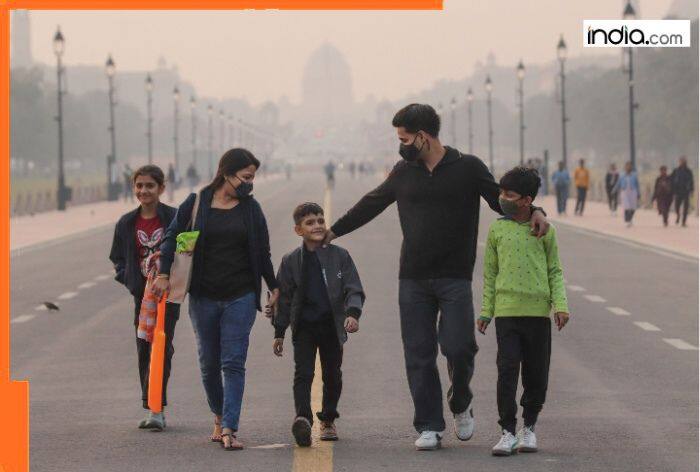
Delhi Air Quality update: As Delhi’s air quality hit season’s worse on Sunday, with the city’s AQI levels racing towards the 500-mark, doctors and medical experts have expressed concerns over the debilitating pollution crisis, and urged citizens in the national capital to practice preventive measures.
What did doctors advise?
Talking to news agency ANI, Doctor Atul Mathur, Interventional Cardiologist and Executive Director at Fortis Escorts Heart Institute, advised residents to “wear light masks” and “reduce their outdoor exposure” in wake of the ongoing pollution crisis in Delhi.
Dr Mathur emphasised the ill effects of the hazardous air quality on public health, and revealed how the two types pollution components– nitrogen oxide and particulate matter– cause long-term harm to humans.
“There are two types of components in pollution. One is gases like nitrogen oxide gas, which is harmful, and the second is particulate matter. When these particles circulate in the body, they inflame the arteries of the body. This is the season where there are a lot of viruses,” he was quoted as saying.

Further, the veteran cardiologist cautioned that the winter season, marked by widespread viral activity, can exacerbate health risks, advising citizens to wear light masks, and reduce outdoor exposure as much as possible.
Delhi air quality nears 500-mark
Delhi air quality hit season’s worst on Sunday as the city’s Air Quality Index (AQI) crashed to a hazardous 497, in the ‘severe’ category at 2 pm, according to Central Pollution Control Board (CPCB) data. The capital city battled toxic fumes as a thick layer of smog blanketed several areas overnight, leaving Delhiites gasping for air.
An AQI between zero and 50 is considered ‘good’, 51 to 100 ‘satisfactory’, 101 to 200 ‘moderate’, 201 to 300 ‘poor’, 301 to 400 ‘very poor’ and 401 to 500 ‘severe’, as per CPCB standards.
On late Saturday evening, the Commission for Air Quality Management (CAQM) invoked GRAP-4 restrictions in Delhi-NCR– imposing the strictest pollution control measures– to prevent further deterioration of air quality in the region.
(With inputs from agencies)


