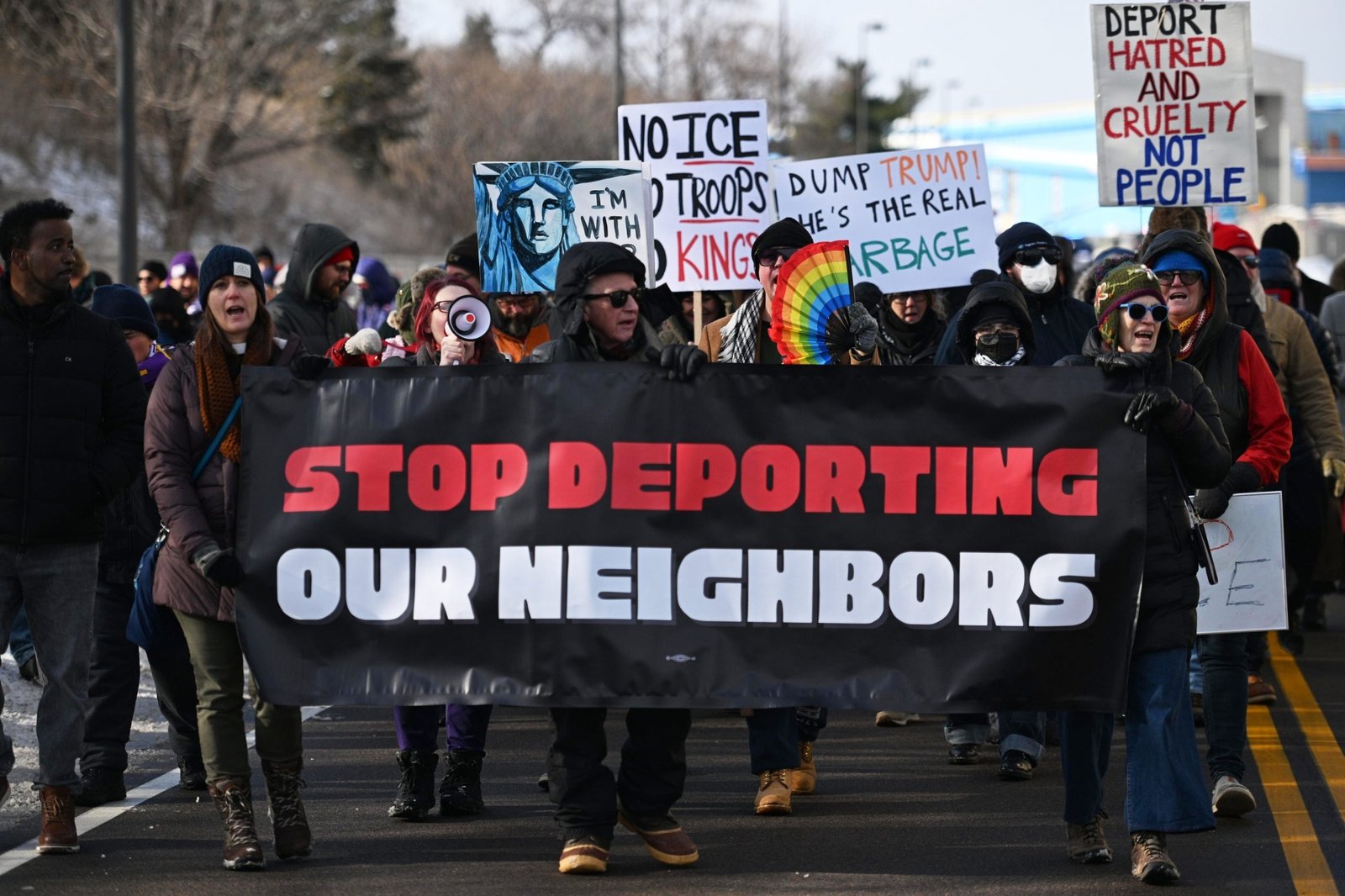
WASHINGTON – From patrolling city streets to rapid on-site protests, defenders of the rights of immigrants are equipped to respond to the Trump administration’s immigrant crackdown in the Twin Cities.
These and other strategies are part of very organized preparations hatched to counter President Donald Trump’s hardline policy toward the nation’s immigrants.
The Immigrant Defense Network (IDN) — an umbrella group of about 100 immigrant, labor, legal, faith and community organizations — has trained about 2,500 Minnesotans to respond to actions by Immigration and Customs Enforcement (ICE), including last month’s road on the Bro-Tex facility in St. Paul.
IDN-trained “constitutional observers” were also dispatched Nov. 25 to a home in St. Paul where an ICE operation turned into a melee and federal agents used tear gas and pepper spray against protesters.
Related: D.C. Memo: Rare success of ‘discharge petition’ emboldens Democrats in battles against Trump
These volunteers deploy observers to scenes of ICE activity and organize public demonstrations and other events in support of the state’s immigrants.
The observers, many of whom are multilingual, are trained and provided secure, toll-free phone and texting options, according to the IDN’s strategic plan.
Edwin Torres, the IDN’s network manager, said a rapid-response team was able to get to the Bro-Tex facility within 12 minutes, and the St. Paul home in 10 minutes.
But the new ICE operations are different, he said, and the “constitutional observers” are now arriving at a site after federal agents have quickly whisked the immigrant they were seeking away.
“We are not seeing large-scale operations this week,” Torres said.
Instead, there have been 20 ICE detentions of individuals — mostly of Latino men and a few Somalis, Torres said — and IDN can do little more than only offer help to tearful families of the immigrants who have been detained. Sometimes, there’s only a car with a broken window left at the scene.
Related: Do administrative warrants allow ICE to enter and search your house?
Undaunted, IDN members are patrolling the streets, sifting through tips to find those that are “credible or verified” and sending alerts when needed by text, email and phone calls to its constitutional observers.
Torres said IDN has a system that uses the boundaries of state House districts to determine which people to call to respond to an incident at a certain address.
Julia Decker, policy director of the Immigrant Law Center of Minnesota, said the state’s immigrant advocates have had time to organize and train volunteers because “it’s taken a little bit longer for this type of surge to reach Minnesota.”
“So, we’ve seen, we had a chance to see some of the tactics that have been used by the federal government and other cities, and so there’s been a little bit more time to prepare and see what we are likely to face,” Decker said.
Trump has ordered immigration crackdowns on Los Angeles, Memphis, Chicago, Washington, D.C., Charlotte, N.C., and, this week, New Orleans and the Twin Cities. The president says the reason for the operations is to fight violent crime he attributes to immigrants.
In the wake of the shooting of two National Guard troops in Washington, D.C., last week, Trump said immigrant communities are “illegal and disruptive populations” that “hate, steal, murder and destroy everything that America stands for.”
Trump said his crackdown on the Twin Cities, which the Department of Homeland Security has dubbed “Operation Metro Surge,” was based on the involvement of Somalis in the Feeding our Future scandal, in which millions of dollars were siphoned off from a pandemic-era program aimed at feeding hungry children. Other scams included one involving reimbursements for assistance for nonexistent services for people at risk for homelessness.
But those involved in the fraud were a fraction of one percent of Minnesota’s 80,000-strong Somali community, most of whom are U.S. citizens or legal residents.
The day after he called Somalis “garbage” during a Cabinet meeting on Tuesday, Trump doubled down on those comments and said Somalia “is considered by many to be the worst country on earth.” He also accused Somali immigrants of having “destroyed the country.”
Meanwhile, U.S. Treasury Secretary Scott Bessent said this week that his agency is investigating allegations that tax dollars from Minnesota were diverted to the militant group Al-Shabaab in Somalia.
‘Living in a time where we have to be careful’
Torres said the idea for IDN was developed after Trump won the 2024 election.
The organization has a seven-member steering committee composed of a variety of both large and small immigrant advocates and human rights groups. They include ACLU-Minnesota, Ayala Leads, COPAL (Communities Organizing Latine Power and Action), the Minnesota Interfaith Coalition on Immigration (ICOM) and the Land Stewardship Project, a group that promotes sustainable agriculture and defends immigrant rights in Greater Minnesota.
Minnesota 8 — an organization that was formed to fight the deportation of eight Cambodian nationals in 2016 and is now an advocate for undocumented Asians in the state — and The Advocates for Human Rights are also members of the steering committee.
Dozens of other groups are affiliated with IDN, including CAIR-Minnesota, an organization that aims to protect the rights of the state’s Muslims.
But information about most of those allied with IDN is not public. And the organization pulled information, including a detailed strategic plan that lays out the group’s operational plans and political goals, from its website after Trump attacked Minnesota’s Somali community this week and his administration launched Operation Metro Surge on Monday.
“Right now, we are living in a time where we have to be careful,” Torres said. “At this moment we have to be more protective of what we have online.”
He said the group’s immediate goal is “to counter the hateful narrative” about immigrants that is coming from the White House with stories about how newcomers to the nation enrich American life.
“We can’t be OK with the rhetoric,” Torres said.
UnidosMN, which organizes Minnesota’s Latino community, is not under the IDN umbrella but also sends volunteers to try to disrupt ICE operations in Minnesota and western Wisconsin under its “Monarca” program.
“It doesn’t matter how many rapid-response teams groups are called for,” UnidosMN spokesman Luis Argueta said. “(IDN) may respond to one side of town and we to another.”
Argueta, however, said the current immigration sweep in Minnesota has prompted some collaboration and conversations between IDN and his organization.
He also said UnidosMN is receiving tips on ICE operations from both the public and elected officials.
A history of immigrant advocacy
Torres said the IDN also plans to lobby the state Legislature, seeking an end to agreements between ICE and local governments and sheriffs in Greater Minnesota, passing “affirmative resolutions” to aid immigrants in the state’s suburbs and advocating for public health and public school policies that are beneficial to immigrant communities.
According to the group’s strategic plan, IDN representatives also plan to spend at least five hours every week meeting with elected officials and “sector influencers” to lobby for immigrant rights.
Trump has characterized protests against ICE actions as unlawful and has characterized some protesters as “thugs” or “domestic terrorists.”
He has also blamed outside agitators and leftist groups for organizing the unrest.
The president’s supporters also share Trump’s views — that immigrants, especially those from Third World countries, are a danger to American society and the American way of life — and support the surge in deportations.
Yet Trump’s plans to crack down on Minnesota’s immigrants are running up against the state’s history and culture.
“Minnesota has a long history of immigration and refugee settlement, and this history has created a comparatively strong infrastructure of immigrant advocacy and support organizations,” said Llana Barber, director of the Immigration History Research Center at the University of Minnesota.
Barber also said that Minnesota, particularly the Twin Cities, also has a “comparatively progressive political culture.”
“Many Minnesotans view the current federal enforcement efforts as grounded in racism and xenophobia and oppose them on those grounds,” Barber said. “They see current efforts to threaten and terrorize immigrants as part of an authoritarian expansion of state power, not a legitimate effort to enforce US law.”
MinnPost reporter Deanna Pistono contributed to this story.
The post Minnesota’s immigrant advocates organize and deploy as Trump ramps up ICE enforcement appeared first on MinnPost.
Leave a Reply