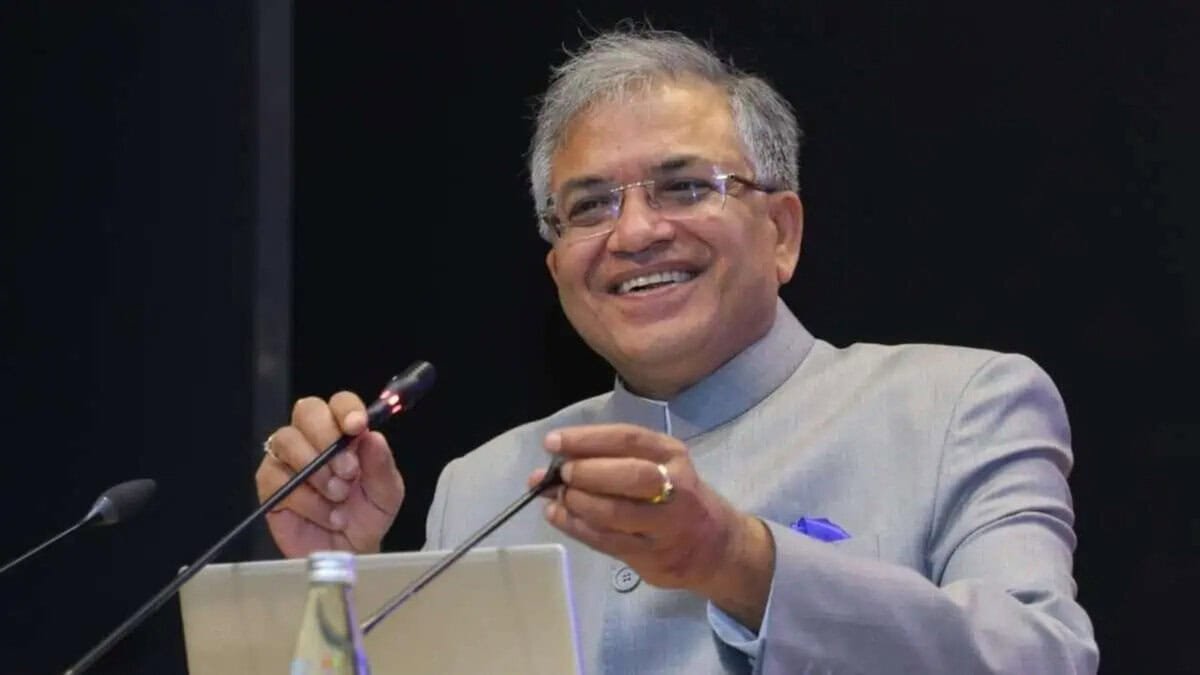
New Delhi: The opposition is likely to submit a notice in both Houses of Parliament to remove Gyanesh Kumar as the chief election commissioner.
This will be the first time that a notice will be submitted to remove a CEC.
The opposition has often accused him of siding with the ruling BJP, disenfranchising genuine voters and helping the saffron party in “vote chori” (stealing votes).
According to the law, a CEC cannot be removed from his office “except in like manner and on the like grounds as a Judge of the Supreme Court.”
The other election commissioners cannot be removed from office except on the recommendation of the CEC.
Here is an explainer on the procedure to be adopted to remove a chief election commissioner:
According to Clause 11 (2) of the Chief Election Commissioner and other Election Commissioners (Appointment, Conditions of Service and Term of Office) Act, 2023, “The Chief Election Commissioner shall not be removed from his office except in like manner and on the like grounds as a Judge of the Supreme Court”.
Supreme Court and high court judges can be removed by Parliament, and the procedure is governed by the Judges (Inquiry) Act, 1968.
Once the notice is accepted in either of the Houses, a motion could be brought in that House of Parliament.
In the Rajya Sabha, at least 50 members have to sign the motion. In the Lok Sabha, 100 members have to support it.
According to the Judges (Inquiry) Act of 1968, once a motion to remove a judge is admitted in any of the Houses, the speaker or the chairman, as the case may be, will constitute a three-member committee to investigate the grounds on which the removal (or, in popular terms, impeachment) has been sought.
The committee consists of the Chief Justice of India (CJI) or a Supreme Court judge, the chief justice of one of the 25 high courts and a ”distinguished jurist”.
The committee proceedings are like any court proceeding where witnesses and the accused are cross-examined.
The CEC, too, will get a chance to speak before the committee.
As per the rule, once the committee submits its report, it will be tabled in the House, and discussions will start to impeach. The motion to remove a judge, and in this case the CEC, will have to be passed by both Houses.
When the House discusses the motion, Kumar will have the right to defend himself standing at the entrance of the House chamber.
Officials aware of the procedure to appoint and remove Supreme Court and high court judges pointed out that while defending his case before lawmakers in any of the Houses, the CEC can announce that he is quitting, and his verbal statement will be considered as his resignation.
Should he decide to resign, he will be entitled to a pension and other benefits of a retired HC judge.
But if he is removed by Parliament, he will be deprived of pension and other benefits, they noted.
Impact Of Gulf War On Nashik: LPG–CNG Supply Issues Raise Auto Fares; Citilinc Fare May Rise | Anand Chaini
Nashik: The impact of the Gulf War is now being felt in India, and LPG and CNG supply problems are arising. This has made private travel in Nashik expensive. The fare of LPG-powered auto rickshaws has increased, and the fare of Citilinc buses, known as the lifeline of the city, is also likely to increase.
At the beginning of the week, the price of LPG had increased from Rs 53.73 to Rs 67.95. That is, there has been a huge increase of Rs 14.22. Due to this, the fare of LPG-powered auto rickshaws has increased by 25 to 30 per cent. The passengers have been shocked by this sudden fare hike, and the impact of the war is seen directly falling on the pockets of the passengers.
On the other hand, the fare of the Citilinc bus service, which is considered the lifeline of the city, is also likely to increase. Like LPG, there is a shortage of CNG. Currently, 244 Citilinc buses are running in the city. Out of these, 50 buses run on diesel, and the remaining 194 buses run on CNG. If there is a shortage of CNG, the fare of Citilinc can be increased. There is no shortage of CNG yet, so the service has not been affected. However, if the situation persists, there is a possibility of reducing bus routes, said Citilinc General Manager Bajirao Mali.
Rumours about LPG, CNG, and petrol-diesel have spread on social media. Due to this, there is an atmosphere of financial instability among the common citizens. Many citizens are going directly to the agency and taking numbers for domestic gas cylinders. It is also seen that they are buying cylinders in the black market by paying more money.
Due to problems in LPG supply, vehicles have lined up at LPG pumps in the city. A large crowd of autorickshaws is seen. There are also queues for kilometres at CNG pumps. If the war continues, the situation is likely to worsen in the next few days.
HPCL has clarified the rumours spread on social media. The company said that such discussions are baseless. Citizens should not trust it. They have also appealed to use fuel carefully.
Citilinc and auto rickshaw drivers are also monitoring the situation, and if fuel availability decreases, services are likely to be affected. The administration has appealed to citizens to use fuel carefully and seek official information instead of believing rumours.
India Monitoring West Asia Situation Closely, Airlines To Expand Connectivity From March 12
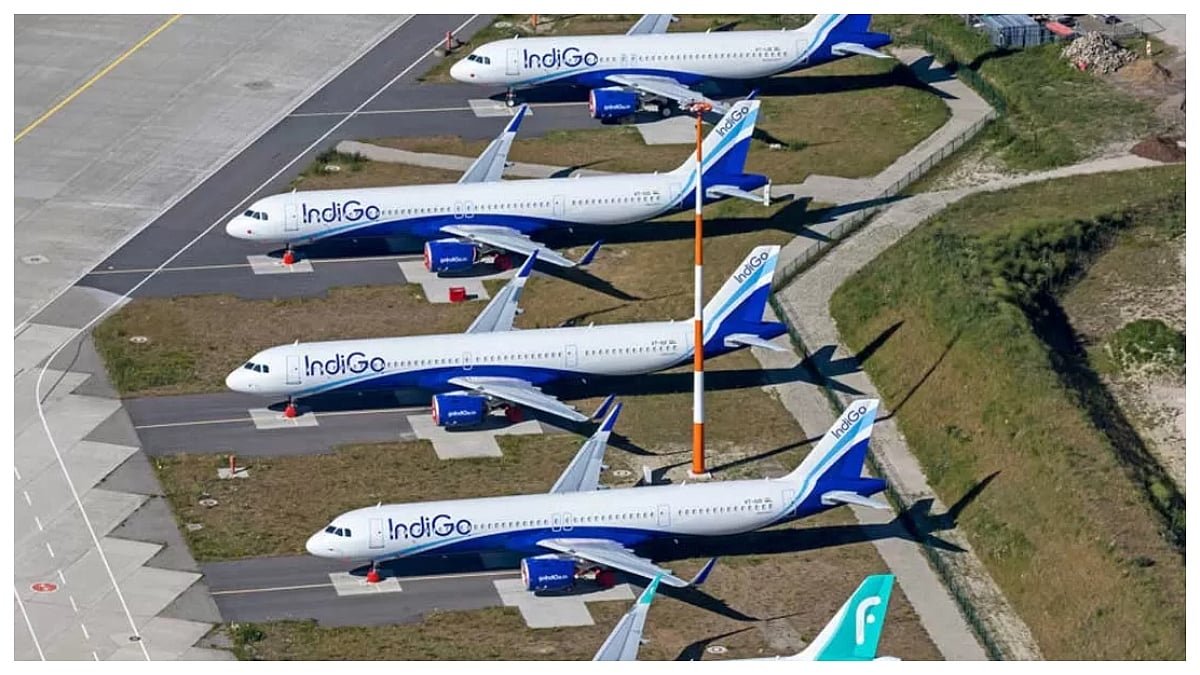
| Representative Pic
India’s Ministry of Civil Aviation is closely monitoring developments in the West Asia region and assessing their possible impact on air travel between India and Gulf countries. Authorities are coordinating with airlines and aviation regulators to ensure safe operations and uninterrupted passenger movement.
The evolving situation in the region has prompted airlines and regulators to review flight operations and contingency plans while maintaining connectivity with key destinations.
Government keeps close watch
Civil Aviation Minister Kinjarapu Ram Mohan Naidu is overseeing the situation and maintaining direct engagement with relevant stakeholders to ensure timely coordination. Officials are monitoring developments in West Asia and evaluating operational responses if the situation affects aviation services.
The Ministry has indicated that airlines are adjusting their operational plans in line with safety requirements while ensuring that services continue without major disruption.
Flights continue between India and West Asia
Operational data from March 9, 2026 shows that Indian carriers operated 45 inbound flights from West Asia into India, carrying a total of 7,407 passengers. The flights arrived from multiple destinations in the Gulf region, highlighting continued connectivity despite the evolving regional situation.
Authorities are also preparing for possible contingencies to ensure safe movement of passengers if operational changes become necessary.
Alternate airport arrangements approved
Indian airlines have requested operational flexibility to manage flight routes safely. In response, the Directorate General of Civil Aviation has coordinated with relevant authorities to facilitate additional arrival and departure slots.
Muscat International Airport has been permitted to function as an en route alternate airport for flights operating to and from destinations such as Dubai, Abu Dhabi, Sharjah, Ras al Khaimah, Al Ain, Fujairah, Jeddah and Medinah.
Airlines plan new services
Airline operational plans indicate that Air India and Air India Express will begin flights to Riyadh starting March 12, 2026. IndiGo is also scheduled to commence Mumbai to Riyadh and Riyadh to Mumbai services from the same date.
SpiceJet has received approvals for alternate airports to maintain operational safety and flexibility. Akasa Air has been advised to align its planned Mumbai to Riyadh services with prevailing operational conditions.
Monitoring fares and passenger movement
The Ministry is maintaining regular coordination with airlines to ensure that passenger movement remains orderly. Authorities are also monitoring airfares to ensure ticket prices remain reasonable and to prevent sudden price increases.
Passengers travelling to or from West Asia have been advised to remain in contact with their respective airlines for updates regarding flight timings and travel arrangements. Officials have said the situation will continue to be reviewed as developments unfold.
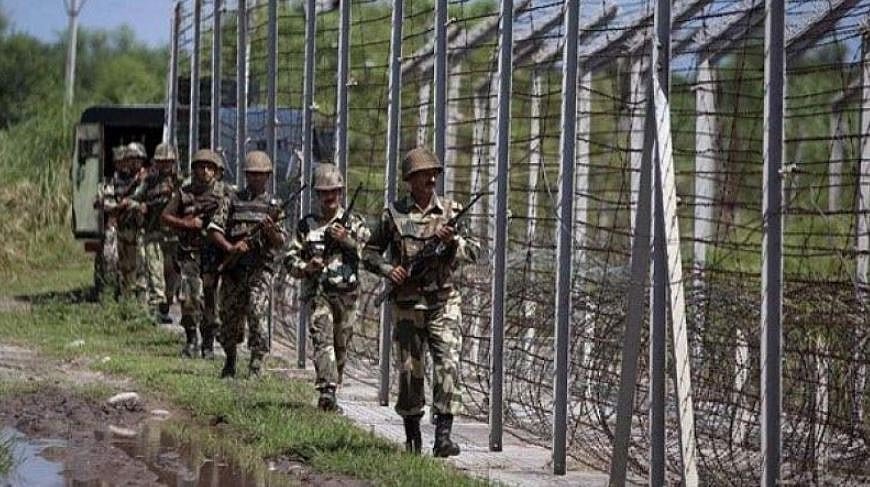
Jaisalmer Tightens Border Vigilance, Bans Pakistani SIMs, Curbs Night Movement | File Pic (Representative Image)
Jaipur: As a precautionary measure, the administration has tightened security arrangements in the areas near the international border in Jaisalmer. The district administration has banned the use of Pakistani local SIM cards and restricted night movement in border villages. New guidelines have also been issued regarding the entry of foreign nationals into protected areas.
District Collector and District Magistrate Pratap Singh said that the network of mobile towers installed in Pakistan across the international border reaches approximately 3-4 kilometers into the Indian territory, which could pose a threat to national security. In light of this, the use of Pakistani local SIM cards has been banned in the district under Section 163 of the Indian Civil Security Code, 2023.
The administration has banned the movement in villages within a five-kilometer radius of the border from 6 p.m. to 7 a.m. This order will apply to several border villages, including Kishangarh, Tanot, Sadhewala, Ghotaru, Longewala, Ganeshia, Langtala, Ratdau, Liloi, and others in Jaisalmer and Pokhran tehsils, and will remain in force until April 30th. According to the order, movement will be prohibited in the said area without the permission of the competent authority. However, officers and employees of the administration, police, Border Security Force, and other agencies on duty are exempted.
Also Watch:
At the same time, following the instructions of the state home department, rules regarding the entry of foreign nationals into the protected areas of the district have tightened. Additional District Magistrate Parsaram said that any foreign national entering protected areas for employment, business, research, study, or tourism purposes has to obtain prior online permission. Tourist operators, guides, hotel operators, and film coordinators have also been instructed not to allow any foreign national to enter protected areas without permission.
Notably, the international border in the Jaisalmer district of Rajasthan measures 464 kilometers, and it is the longest stretch of border shared by any single district of Rajasthan with Pakistan.
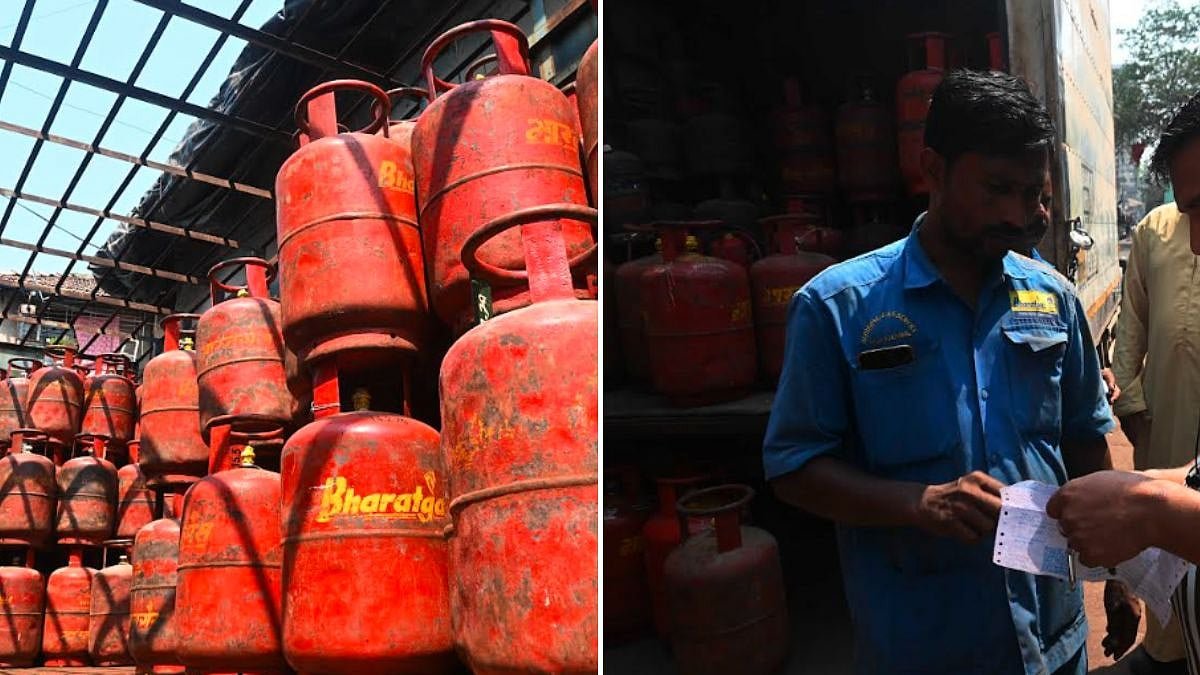
A shortage of commercial LPG cylinders has pushed nearly 800 to 1,000 factories in the state to the verge of closure, raising concerns about the livelihood of more than 50,000 workers employed in these units. | Pics | Vijay Gohil
Lucknow: A shortage of commercial LPG cylinders has pushed nearly 800 to 1,000 factories in the state to the verge of closure, raising concerns about the livelihood of more than 50,000 workers employed in these units.
Critical Sectors Hit by the Gas Supply Disruption
Industries dependent on heating processes such as carton box manufacturing, packaging, pharmaceuticals, snack production and fabrication have been hit the hardest as gas supplies have slowed drastically. Industrial units said many factories may be forced to shut operations within a day or two if supplies are not restored.
Lucknow has around 45 to 50 factories linked to the carton box and packaging industry. These units rely on gas to heat rollers used in manufacturing corrugated sheets. The rollers are heated through burners installed inside them, which help in shaping cardboard into packaging material.
Food Processing and Pharmaceutical Sectors at Risk
Food processing units producing snacks, biscuits and chips also depend heavily on commercial LPG for frying and cooking. Similarly, pharmaceutical companies that prepare syrups require large vessels to heat medicinal solutions using gas.
The shortage has also affected the fabrication industry where building gas prepared by mixing LPG and oxygen is used for cutting and welding. More than 500 small and large units in the district are engaged in fabrication work and many are now facing the risk of halting production.
Entrepreneurs said the situation remains grim despite the government stating on Tuesday that production units and industrial consumers would be supplied 80 percent of their gas requirement.
While small industries and restaurants have been hit hard, businesses connected to piped natural gas have largely remained unaffected. Green Gas Limited AGM Praveen Singh said the supply of PNG is being closely monitored and current demand is being met.
Lucknow’s Gas Consumption and the Privileged Few
Lucknow consumes around 3.5 lakh standard cubic metres per day of gas. The supply is divided into commercial and industrial categories. About a dozen large hotels and restaurants in the city, including Chhappan Bhog, Mahesh Namkeen and Lucknow airport, are connected to PNG. In the industrial sector, companies such as Amul, Karam, Ashok Leyland and Surya Food receive PNG supply.
Indian Industries Association Lucknow chapter president Vikas Khanna said even bookings made two days earlier are not being delivered. According to him, gas agencies claim that supply has been restricted from higher authorities.
He said the government’s announcement about supplying 80 percent gas to production units has not provided any relief so far. Khanna added that shortages combined with supply limits could encourage black marketing and force entrepreneurs to depend on agencies for cylinders.
A Factory Owner’s Personal Countdown to Closure
Industrialist Ankit Jain, who runs a carton box manufacturing unit, said his factory consumes two to three cylinders daily. “We are not getting commercial or domestic cylinders. Only one or two days of stock is left. If fresh cylinders do not arrive, the factory will have to shut,” he said.
Indian Industries Association vice president Abhinav Kapoor said vendors supplying components to Tata Motors are also facing difficulties. Units manufacturing auto parts in the Chinhat industrial area require gas for powder coating processes.
He said nearly 80 percent of industries in the area produce auto parts for Tata Motors but are unable to get gas cylinders. If the situation continues, units may be forced either to shut down temporarily or shift to diesel-based machines.
Entrepreneur Adnan Siddiqui said fabrication work has already slowed because metal cutting operations depend on gas. “We managed with the small stock we had, but new orders are now getting stuck due to lack of gas,” he said.
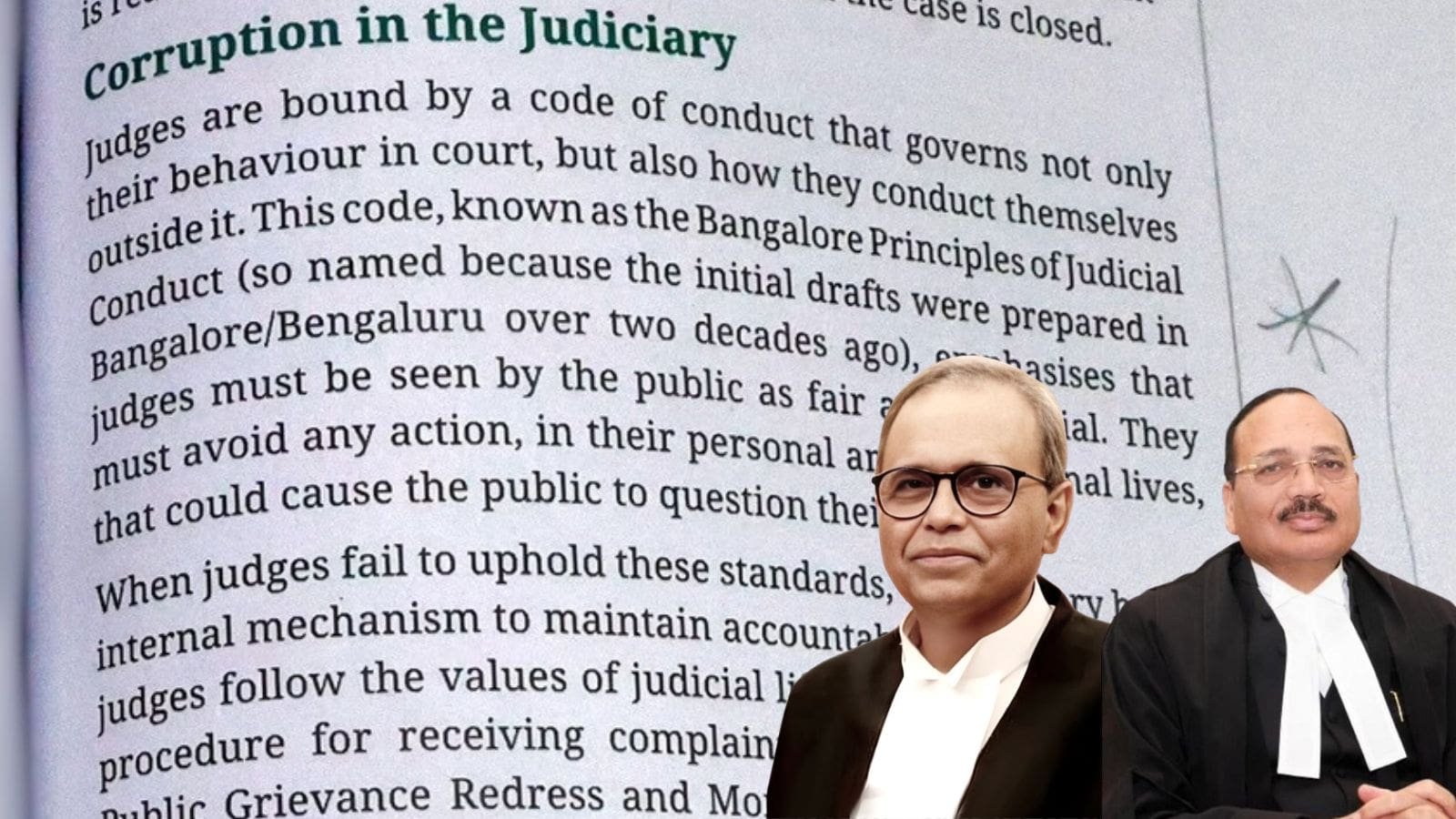
New Delhi: Acting tough against three experts involved in drafting of a controversial chapter in the National Council of Educational Research and Training (NCERT) Class 8 social science book containing “offending” contents on corruption in the judiciary, the Supreme Court on Wednesday, March 11, directed the Centre and all state governments to disassociate from them.
The apex court directed the Centre to constitute a committee of domain experts within a week for the purpose of finalising the curriculum of NCERT’s legal studies of not only Class 8 but higher classes also.
A bench headed by Chief Justice Surya Kant was informed that the chapter was drafted by the textbook development team under the chairmanship of Professor Michel Danino and consisting of members Suparna Diwakar and Alok Prasanna Kumar.
“At the outset, we have no reason to doubt that Professor Michel Danion and his associates Suparna Diwakar and Alok Prasanna Kumar either do not have reasonable informed knowledge with respect to the Indian judiciary and/or they deliberately and knowingly misrepresented the facts in order to project a negative image of Indian judiciary before the students of class 8…,” the bench said.
The top court said it sees no reason why these persons should be associated in any manner for the purpose of preparing the curriculum or finalising textbooks for the next generation of children.
It directed the Centre, state governments and Union Territories, universities, and public institutions receiving government funds to “disassociate three of them forthwith and not to assign any responsibility which incur fully or partially public funds.”
It said this order, however, shall be subject to their approaching the top court for modification along with an explanation, if any, they wish to tender.
Bench unsettled over NCERT rewriting the chapter
The bench, also comprising Justices Joymalya Bagchi and Vipul M Pancholi, said it was “equally perturbed” with the stand taken by the NCERT director in his affidavit that the chapter has been “duly rewritten”.
“We direct that if at all chapter 4 of the subject textbook has been rewritten, the same shall not be published unless it is approved by a committee comprising domain experts,” it said.
The bench said the Centre should also revisit the composition of National Syllabus and Teaching Learning Material Committee (NSTC), especially those with whom the offending chapter was digitally shared by members of the textbook development team.
It noted that after it had passed the February 26 order in the matter, some elements in “so-called social media” had acted and reacted irresponsibly.
“We firmly believe in catching the bull by the horn. We accordingly direct the Government of India to identify such sites, the persons behind running those sites and furnish their full details to enable us to take suitable action,” it said, adding that law must take its own course against “mischief mongers.”
Centre directed to constitute a committee of domain experts
The bench directed the Centre to constitute a committee of domain experts, which may preferably include one former senior judge, one eminent academician, and one renowned practitioner in law.
It said it would be appreciated if the committee of domain experts also associates the National Judicial Academy, Bhopal, for the purpose of finalising the NCERT’s curriculum of legal studies.
The bench said it found it “slightly disappointing” that not a single eminent jurist was included if NCERT wished to teach the students about the judiciary.
“We, however, leave it to the discretion of the competent authority for reconstitution of the NSTC,” it said.
The bench made clear that its orders were not intended to prevent any healthy, objective, and legitimate criticism of the institutional functioning of the judiciary.
It noted that Professor Dinesh Prasad Saklani, Director of the NCERT, has filed an affidavit tendering unconditional and unqualified apology on his behalf and on behalf of NCERT for the inclusion of the chapter.
It noted that the Secretary of the Department of School Education and Literacy of the Ministry of Education has also filed an affidavit tendering unconditional and unqualified apology.
During the hearing, Solicitor General Tushar Mehta said the Centre has already directed NCERT to review textbooks of all standards, not just class 8.
“Instead of giving it to the NCERT, we would have appreciated if the central government itself constituted some high-level committee,” the CJI observed.
To this, Mehta said, “It shall be done. It would be neutral, independent domain experts.”
Referring to the affidavit filed by the NCERT director, the bench said, “This affidavit is an eye-opener that the curriculum is issued without getting it approved at any level.”
“If this is the casual way of publishing the curriculum for the students in this country, Mr Solicitor General, what do you expect us to do?” the CJI asked.
Mehta said this needed a “systemic change,” which has already started.
When the bench said the three persons be forthwith disassociated, Mehta said, “We have already said on our own that we are disassociating them.”
The bench observed that the affidavit filed by NCERT director said that these individuals would not be associated with any activity of NCERT only.
“What if one of them is appointed as vice-chancellor tomorrow,” the CJI said.
On February 26, the apex court imposed a “complete blanket ban” on any further publication, reprinting or digital dissemination of NCERT’s class 8 social science book as it contains “offending” contents on corruption in the judiciary, saying they have fired a gunshot and the judiciary is “bleeding”.
Those days are long gone when one would join their first company and serve till the age of retirement. In the age of open economy and options to switch, employees are on the hunt for better opportunities all the time.
However, an extreme case of this culture came into light when one Gurgaon-based startup co-founder fumed over a candidate who tried to negotiate the salary package just two days before the joining date.
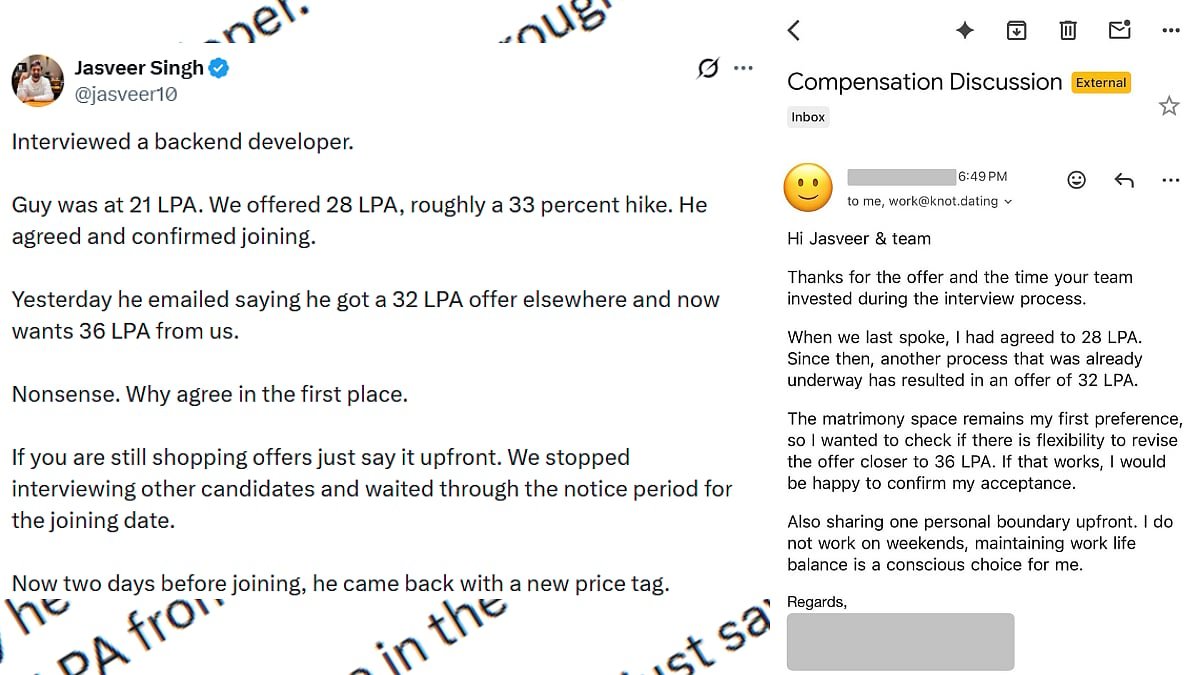
The co-founder of Knot Dating, an Indian matchmaking platform, Jasveer Singh on Wednesday took to X (formerly Twitter) with a screenshot of a mail to highlight the misuse of offer letters.
In the screenshot, he showed a mail from a candidate who was selected by Singh’s startup to work as a backend developer. But two days before the joining date, he sent an email asking to raise the salary package from Rs 28 LPA to Rs 36 LPA.
That would be over 70 percent hike than the candidate’s current salary of Rs 21 LPA.
The reason explained in the mail was that the candidate was being offered Rs 32 LPA from another company.
“Interviewed a backend developer. Guy was at 21 LPA. We offered 28 LPA, roughly a 33 percent hike. He agreed and confirmed joining,” Singh tweeted with the screenshot of the mail. However, the name and email address of the candidate was not revealed.
“Yesterday he (the candidate) emailed saying he got a 32 LPA offer elsewhere and now wants 36 LPA from us.
Nonsense. Why agree in the first place.
If you are still shopping offers just say it upfront. We stopped interviewing other candidates and waited through the notice period for the joining date. Now two days before joining, he came back with a new price tag,” Singh said further in his post.
While some of the Twitter users agreed with Singh’s argument that agreements once signed should be respected, others took the side of the candidate arguing that it was his right to get the best offer in this capitalist world.
One X user said, “What’s wrong with this? Candidate has all rights to negotiate. He has skills that are in demand. This is capitalism world, companies do the same – reorg, firing, etc.”
To this, Singh replied, “There is nothing wrong with negotiation. The problem is doing it after agreeing and confirming the joining date. Negotiation should happen before the commitment, not after it. It’s like saying that after getting engaged, your fiancé is still going out on dates.”
However, some users also advised him to get the job agreements signed so that next time such candidates can be taken to court for breach of the agreement.
When Lalisa Manobal, aka Lisa, arrives, you already know it’s going to be a major fashion moment, and she did just that at her recent Paris Fashion Week appearance At the Louis Vuitton show, the BLACKPINK singer-rapper turned heads in a dreamy butter-yellow, proving soft pastel shade is ruling the style scene for the upcoming spring season Lisa oozed chic elegance in a fitted, long-sleeve crop top in the creamy hue, showing off a sleek silhouette while keeping the look modern and effortlessly coolThe ensemble featured a long open black layer underneath, styled with edgy double-belts that pulled the look together
The dancer balanced the soft tone of the top with sleek leather pants, complemented with matching bag and sleek boots
Her makeup makeup was equally soft and luminous with a dewy skin, soft rosy cheeks, and nude tones, enhancing the hue of the top
Lisa rounded off her Paris glam with her half-up and half-down hairstyle, while her signature bangs framed her face perfectly
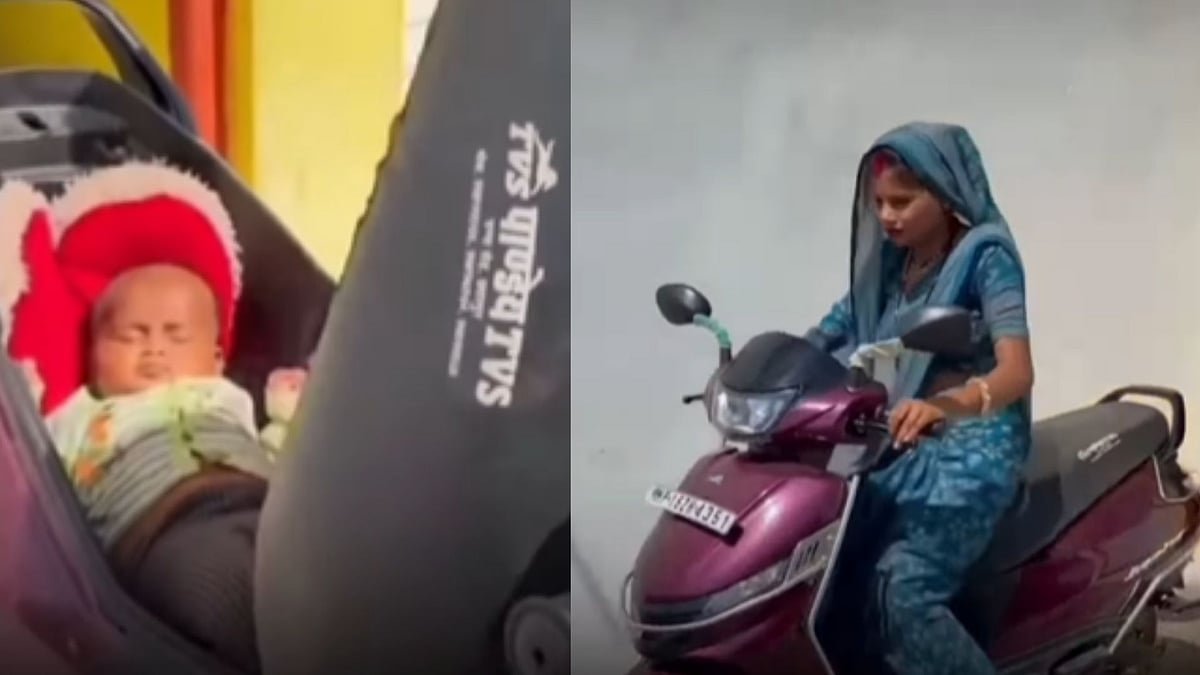
A disturbing video circulating widely on social media has triggered strong reactions from viewers after it appeared to show a woman placing her infant inside the storage compartment of a scooter before riding away. The clip has left many people alarmed, with several questioning the child’s safety and criticising the act as extremely risky.
Viral video shows unusual scene outside house
The video begins with a woman standing near the entrance of what looks like a residential house. She is holding a small baby in her arms while standing beside a parked scooter.
Moments later, she lifts the scooter’s seat to open the storage compartment located underneath. These compartments are typically designed to store items such as helmets, small bags, documents, or personal belongings.
In the footage, the woman gently places the infant inside the storage space. The baby, who appears to be wearing a cap, is seen lying quietly while the woman adjusts the child’s position inside the compartment.
Baby hidden as seat is closed
After positioning the baby, the woman lowers the scooter seat and shuts the compartment, making the infant completely invisible from the outside.
The video then shows the woman getting onto the scooter, adjusting the handle and preparing to leave. She soon rides away from the location, with the child still inside the closed storage box.
Observant viewers noticed that the scooter’s number plate begins with the registration code “MP,” suggesting the vehicle could be registered in Madhya Pradesh.
Social media users express concern
The clip quickly spread across different platforms, drawing widespread attention and criticism. Many viewers expressed shock and disbelief, calling the act irresponsible and dangerous for the infant.
Several people pointed out that scooter storage compartments are not designed to carry passengers and do not provide proper ventilation or safety for a child.
One user wrote, “Kaise kaise log parents ban jaate hain!” Another commented, “Hope this is just a script.” A concerned viewer asked, “Saas kaise lega woh bacha?” while another person said, “Thode toh common sense hona chahiye. Agar bachi ko saans nahi aaye toh kya karoge?”
Another comment read, “It’s dangerous. Don’t do things like this just for fun.”
A chaotic scene from Basti in Uttar Pradesh has gone viral on social media, showing dozens of people rushing to secure LPG cylinders outside the Mahadeva Gas Agency amid rumours of a cooking gas shortage.
The short clip captures a large crowd pushing and jostling near the distribution area, with several individuals hurriedly carrying the standard red domestic LPG cylinders on their shoulders.
People Seen Running With Cylinders
In the roughly 15-second video posted online, men can be seen running or quickly walking away with cylinders in hand while others crowd tightly near the loading area.
The atmosphere appears tense and disorderly, with little sign of organised queues. Many people seem eager to secure cylinders quickly, reflecting fears of an imminent supply disruption.
Rumours Linked To West Asia Tensions
The panic buying reportedly stems from speculation that the ongoing geopolitical tensions in West Asia could disrupt LPG imports to India.
Rumours circulating on social media suggested that cooking gas supplies could be affected due to the broader conflict involving Iran and Israel, prompting people in several areas to stock up on cylinders.
Government Denies Any Shortage
However, authorities have repeatedly clarified that there is no shortage of LPG in the country.
Piyush Goyal, India’s Union Minister for Commerce and Industry, assured the public that fuel supplies remain stable and that there is no disruption in availability.
Officials from the Petroleum Ministry also stated that India has adequate domestic stocks and that distribution networks remain fully operational.
Panic Fuelled By Social Media Rumours
Despite official reassurances, visuals from several gas agencies in parts of Uttar Pradesh suggest panic buying triggered by misinformation.
Experts say such scenes highlight how quickly rumours can spark hoarding behaviour, especially during periods of international uncertainty.
Observers have also drawn comparisons with the rush for oxygen cylinders during the COVID-19 pandemic, when fears of shortages triggered similar panic across the country.
Authorities have urged citizens not to believe unverified social media claims and to rely only on official announcements regarding fuel availability.