Bhopal: An Air India flight from Delhi to Bengaluru with 172 persons on board was diverted to Bhopal due to a technical snag and made a safe landing under emergency conditions at the Raja Bhoj Airport here on Monday night, an official said.
The flight (AIC 2487, A320 Neo, VT-EXO) was diverted to Bhopal airport after a warning was reported in the cargo hold of the plane, the airport official said.
“Following standard safety procedures, a full emergency was declared at 1933 IST. A few minutes later, the crew confirmed that the warning had cleared and all aircraft systems were normal. The flight landed safely at 2000 IST with 172 persons on board. All operations are normal,” the official said.
The diversion was handled promptly by Air Traffic Control, Airport Fire Services, and airlines at Bhopal Airport. Operations were not affected, said Airport Director Ramji Awasthi.
Mumbai: The rupee extended its descent for the third straight day and settled seven paise down at 88.77 (provisional) against the US dollar on Monday, near its all-time low level, weighed down by a strong American currency and foreign fund outflows.
Forex traders said domestic equities ended on a positive note and supported the domestic unit at lower levels.
Moreover, intervention by the Central Bank also offered some cushioning.
At the interbank foreign exchange, the rupee opened at 88.73 and touched an intraday low of 88.80 against the greenback. The unit ended the session at 88.77 (provisional) against the dollar, logging a loss of 7 paise from its previous closing level.
The rupee had ended one paisa lower at 88.70 against the dollar on Friday, a day after crashing 47 paise on Thursday, following the hawkish commentary by US Federal Reserve chair Jerome Powell, even as the Fed reduced the interest rate by 25 basis points.
The domestic currency has recorded its lowest-ever closing level of 88.81 against the dollar on October 14.
“The Indian rupee drifted toward a record low on Monday, dragged down by regional currency weakness and dollar outflows. Although the central bank intervened mid-session to offer some cushioning, strong dollar demand ultimately prevailed, pushing the rupee pair to a session low before it settled with a small loss,” said Dilip Parmar – Senior Research Analyst, HDFC Securities.
Parmar further added that near-term technical chart showed support at 88.55 and resistance at 89.25.
Meanwhile, the dollar index, which gauges the greenback’s strength against a basket of six currencies, rose 0.16 per cent to 99.96.
Brent crude, the global oil benchmark, was up 0.22 per cent to USD 64.87 per barrel in futures trading.
According to Jateen Trivedi, VP Research Analyst – Commodity and Currency, LKP Securities, the rupee traded weak as strength in the dollar index exerted pressure on the domestic currency.
“Continued FII selling added to the downside, even as positive developments emerged from US statements hinting at progress toward a trade deal with India. The broader sentiment remains cautious ahead of key US data releases this week, including ISM Manufacturing and Non-Manufacturing PMI, which could further influence global risk appetite and currency movements.
“The rupee is expected to trade within a range of 88.45–89.25 in the near term,” Trivedi said.
On the domestic equity markets front, the Sensex rose 39.78 points or 0.05 per cent to settle at 83,978.49, while the Nifty gained 41.25 points or 0.16 per cent to end at 25,763.35.
Foreign institutional investors sold equities worth Rs 1,883.78 crore on Monday, according to exchange data.
A monthly survey released on Monday showed India’s manufacturing sector activity strengthened in October, buoyed by Goods and Services Tax relief, productivity gains and tech investment, even as international sales rose at a weaker pace.
The seasonally adjusted HSBC India Manufacturing Purchasing Managers’ Index (PMI) rose from 57.7 in September to 59.2 in October, indicating a quicker improvement in the sector’s health.
Meanwhile, India’s forex reserves dropped by USD 6.925 billion to USD 695.355 billion during the week ended October 24, the RBI said on Friday.
In the previous reporting week, the overall reserves had increased by USD 4.496 billion to USD 702.28 billion.
Seattle: OpenAI and Amazon have signed a USD 38 billion deal that enables the ChatGPT maker to run its artificial intelligence systems on Amazon’s cloud computing services.
OpenAI will get access to “hundreds of thousands” of Nvidia’s specialised AI chips through Amazon Web Services as part of the deal announced Monday.
The agreement comes less than a week after OpenAI altered its partnership with its longtime backer Microsoft, which is no longer the startup’s exclusive cloud provider.
California and Delaware regulators also last week allowed OpenAI, which was founded as a nonprofit, to move forward on its plan to form a new business structure to more easily raise capital and make a profit.
“The rapid advancement of AI technology has created unprecedented demand for computing power,” Amazon said in a statement Monday. It said OpenAI “will immediately start utilizing AWS compute as part of this partnership, with all capacity targeted to be deployed before the end of 2026, and the ability to expand further into 2027 and beyond.”
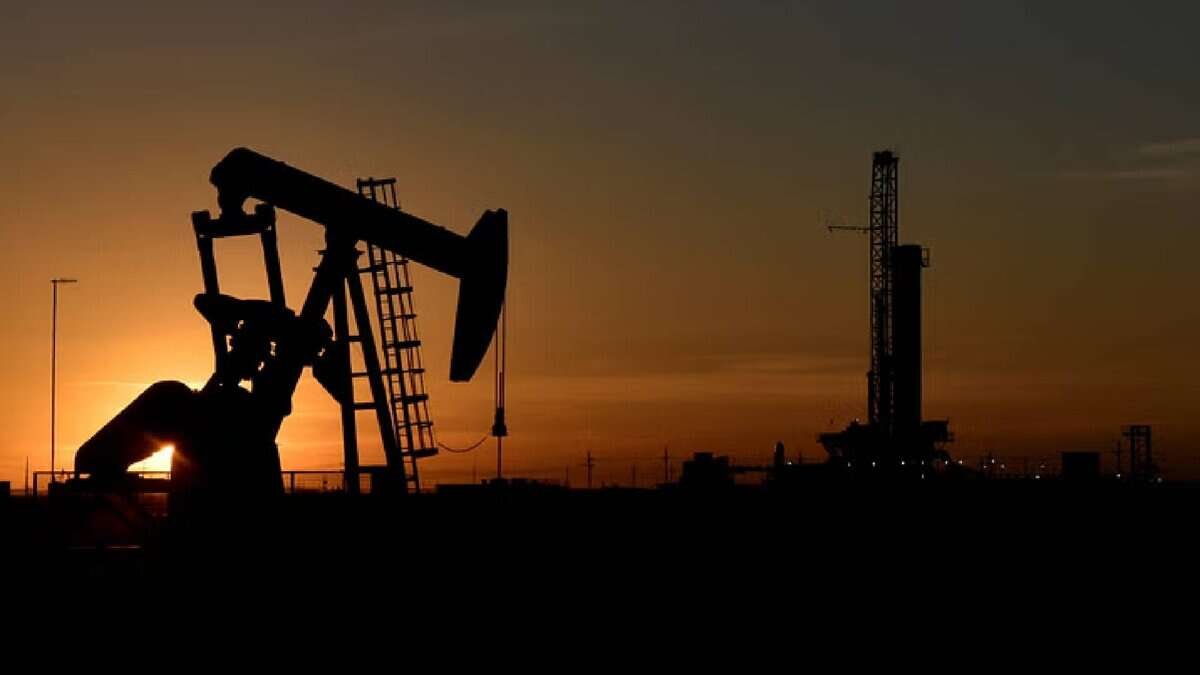
Oil field machinery silhouetted against a sunset sky. Photo: X
New Delhi: Crude oil prices on Monday rose Rs 32 to Rs 5,454 per barrel in futures trade as participants increased their positions following a firm spot demand.
On the Multi Commodity Exchange, crude oil for November delivery traded higher Rs 32 or 0.59 per cent at Rs 5,454 per barrel in 15,062 lots.
Analysts said raising of bets by participants kept crude oil prices higher in futures trade.
Globally, West Texas Intermediate crude was trading 0.64 per cent higher at USD 61.37 per barrel, while Brent crude rose 0.65 per cent to USD 65.20 per barrel in New York.
New Delhi: India’s exports to the US have dipped 37.5 per cent during May-September 2025 from USD 8.8 billion in May to USD 5.5 billion in September, think tank GTRI said on Sunday.
It said that exports of pharmaceuticals, smartphones, metals and auto have declined during the period.
Pharmaceutical product exports dipped 15.7 per cent from USD 745.6 million in May to USD 628.3 million in September. Industrial metals and auto parts facing uniform tariffs for all countries saw a modest 16.7 per cent drop, from USD 0.6 billion to USD 0.5 billion.
Aluminium exports fell 37 per cent , copper 25 per cent, auto parts 12 per cent, and iron-steel 8 per cent, GTRI Founder Ajay Srivastava said, adding that with similar duties on global suppliers, the dip likely reflects softer U.S. industrial activity rather than lost competitiveness.
He added that labour-intensive sectors such as textiles, gems and jewellery, chemicals, agri-foods, and machinery endured a 33 per cent decline, from USD 4.8 billion to USD 3.2 billion.
“The impact here was both deep and widespread,” he said.
Exports of solar panels dropped 60.8 per cent from USD 202.6 million in May to USD 79.4 million in September.
In textiles and garments also, shipments fell 37 per cent, from USD 944 million to USD 597 million.
“Garments were down 44 per cent, home textiles 16 per cent, and yarn and fabrics 41 per cent,” he said adding marine and seafood exports declined 49 per cent, from USD 223 million to USD 113 million, dealing a severe blow to one of India’s most labour-intensive export sectors..
The US imposed a total of 50 per cent tariff on a wide range of Indian products effective from August 27.
Sriharikota: ISRO has set a target to launch seven missions, including its ambitious first uncrewed mission under the Gangayaan programme, before the end of March 2026, Chairman V Narayanan said on Sunday.
The Bengaluru-headquartered space agency has planned to make three uncrewed missions before the crewed mission under the Gaganyaan programme, and the first uncrewed launch ‘G1 Mission’ is expected to happen by March 2026, he said.
“Our Gaganyaan programme is progressing well. It is in advanced stages. All hardware have arrived at Sriharikota and integration (of the hardware) is happening. We have planned three uncrewed mission. The first uncrewed mission, ‘G1 Mission’, is going to be achieved before the end of the current financial year,” he said.
Narayanan was speaking to reporters after the successful launch of communication satellite CMS-03 onboard a LVM3-M05 rocket from this spaceport.
On the future mission programmes, Narayanan, who is also the Secretary, Department of Space, said seven missions have been planned before the end of March 2026.
He said this initiative was under Prime Minister Narendra Modi’s vision for ISRO to make 50 rocket launches over the next five year period.
“We have planned seven launches to take place before the end of this financial year. It is by March 2026,” he said.
Giving some insights on the planned missions, he said after Sunday’s LVM3-M05 launch, ISRO would undertake another LVM3 rocket launch which would carry a ‘commercial communication satellite’ for a client.
“After that, we have got three more PSLV missions. One is for NSIL customer satellite,” he said.
NewSpace India Ltd (NSIL) is the commercial arm of the ISRO.
Narayanan said ISRO has also planned for another technology development mission PSLV-N1 targeted to be launched before the end of the current financial year.
“So many developments are taking place. We have also planned for a GSLV-F17 rocket mission before March 2026,” he said.
Noting that ISRO has drawn up various missions by March 2026, he said, “I know it is not an easy job. It is a tough job. But I know that we will accomplish these activities (in future).”
“Team ISRO is geared up to meet the vision of the Prime Minister to launch 50 missions in the next 5 years,” he added.
Amaravati: Andhra Pradesh collected Rs 3,021 crore in net Goods and Services Tax (GST) revenue last month—the second-highest for any October since GST was introduced in 2017, the state’s Commercial Taxes Department said.
According to the department, the state registered an 8.77 per cent growth in net GST collections compared to October 2024, despite rate reductions on several goods. Gross GST collections stood at Rs 3,490 crore, reflecting a 2.54 per cent year-on-year increase.
“Net GST collections for October 2025 reached Rs 3,021 crore, marking the second-highest ever for October since GST’s inception in 2017,” the department said in a release on Saturday.
During the month, State GST (SGST) collections stood at Rs 1,247 crore, recording a 6.2 per cent rise compared to the same period last year. Integrated GST (IGST) settlements contributed Rs 1,773 crore, up 10.65 per cent from October 2024.
Petroleum product VAT collections rose 7.88 per cent to Rs 1,282 crore, helping sustain the state’s overall revenue momentum, the release added.
Professional tax collections also registered a strong growth of 18.26 per cent in October, with a cumulative increase of 46.55 per cent for the financial year so far.
From April to October 2025, net GST collections have consistently surpassed those recorded in the same period last year, underscoring strong economic activity and improved tax compliance, the department said.
Total tax collections across all sectors for October 2025 stood at Rs 4,458 crore, reflecting an 8.03 per cent year-on-year increase.
The department attributed the sustained revenue growth to the use of advanced data analytics and AI to detect tax evasion and discrepancies, enabling targeted audits and enhanced compliance.
Other key measures included better coordination between central and state tax authorities, particularly on IGST reversal mechanisms for accurate settlements, and performance-based deployment of high-performing officers to critical zones to improve efficiency and accountability.
Improved return filing compliance—driven by strict enforcement and early detection of irregularities—also helped prevent potential revenue leakages, the release added.
New Delhi: Adani Solar has crossed a major milestone by shipping over 15,000 megawatts (MW) of solar modules across domestic and international markets – becoming the first and fastest Indian manufacturer to achieve this feat.
Of the total shipments, 10,000 MW were deployed within India and 5,000 MW exported abroad, equivalent to 28 million modules covering nearly 7,500 football fields, officials said.
Around 70 per cent of these modules were produced using Adani’s India-made solar cells, reinforcing the company’s role in advancing the Make in India and Atmanirbhar Bharat initiatives.
Adani Solar plans to more than double its production capacity from 4,000 MW to 10,000 MW by the next financial year and aims to ship another 15,000 MW in the coming years.
The company is the only Indian manufacturer listed among the world’s top 10 solar module producers by research firm Wood Mackenzie.
Wood Mackenzie, in a report last week, said India’s solar module manufacturing capacity is on track to surpass 125 GW by 2025, more than triple the domestic market demand of around 40 GW.
The report, ‘Perfect Storm in the Indian Solar Supply Chain’, stated that despite near-term challenges, India has the clearest potential to become a large-scale alternative to China‘s solar supply chain dominance.
With a retail presence in over 550 districts through 35 exclusive channel partners, Adani Solar operates India’s largest solar module distribution network, making high-quality, locally manufactured solar products widely accessible.
“Our 15,000 MW milestone reflects Adani Solar’s strong commitment to India’s energy independence and clean energy future,” said a company spokesperson.
The impact of Adani Solar’s shipments includes 5 million homes powered with affordable solar energy, 2,500 green jobs created, 60 million tonnes of carbon dioxide emissions avoided annually and modules spanning 65,000 km, enough to circle the Earth 1.5 times, officials said.
India’s solar manufacturing capacity has surged from 2.3 GW in 2014 to an estimated 100 GW by 2025, with over 100 domestic manufacturers now active in the sector.
In the first half of FY26, India’s solar exports rose 20 per cent year-on-year to USD 668 million, driven by strong demand from the US, UAE, Kenya, Hungary, and Iran.
Adani Solar also leads India’s rooftop solar segment, having supplied 1.78 GW of modules in the past year, enough to power 5,94,000 homes. The company provides 54 per cent of modules for the government’s Surya Ghar: Muft Bijli Yojana, which targets solar power to 10 million households by 2027.
With over half of India’s installed electricity capacity already sourced from non-fossil fuels – five years ahead of its Paris Agreement target – the country is on track to achieve 500 GW of clean energy capacity by 2030.
Adani Solar, with its end-to-end manufacturing capability from ingots and wafers to modules and ancillary materials, such as solar glass, EVA, and aluminium frames, continues to play a pivotal role in India’s transition toward sustainable energy independence, they added.
New Delhi: The Unique Identification Authority of India has formed a high-level expert panel to make Aadhaar technology future-ready, especially for scalability and resilience against evolving cybersecurity threats, an official statement said on Friday.
The high-level expert committee has been constituted under the chairmanship of UIDAI, Chairperson, Neelkanth Mishra.
It comprises UIDAI CEO Bhuvnesh Kumar, Nutanix founder Dheeraj Pandey, MOSIP head of engineering Sasikumar Ganesan, Trilegal partner Rahul Matthan, Amrita University Professor Prabaharan Poornachandran, Michigan State University Professor Anil Jain, UIDAI deputy director general Abhishek Kumar Singh, Sarvam AI Co-Founder Vivek Raghavan and IIT Jodhpur professor Mayank Vatsa.
“Recognising the rapidly changing technological and regulatory landscape, the UIDAI has embarked on a comprehensive strategic and technological review to shape the next decade of Aadhaar’s evolution through a new ‘Aadhaar Vision 2032’ framework. To guide this ambitious transformation, UIDAI has constituted a high-level Expert Committee under the chairmanship of Shri Neelkanth Mishra, Chairperson, UIDAI,” the statement said.
The Vision 2032 roadmap will look at not only sustaining the technological leadership of Aadhaar but also reinforcing its role as a secure, inclusive, and people-centric digital identity, the statement said.
The committee will develop the Aadhaar Vision 2032 document, outlining the framework for next-generation Aadhaar architecture aligned with India’s Digital Personal Data Protection (DPDP) Act, and emerging global standards of privacy and cybersecurity.
“The Aadhaar Vision 2032 framework will focus on leveraging cutting-edge technologies such as Artificial Intelligence (AI), Blockchain, Quantum Computing, Advanced Encryption, and next-generation Data Security mechanisms. These will ensure Aadhaar remains resilient against evolving cybersecurity threats, scalable for future demand, and adaptive to the rapidly changing digital landscape,” the statement said.
Mumbai: India’s forex reserves dropped by USD 6.925 billion to USD 695.355 billion during the week ended October 24, the RBI said on Friday.
In the previous reporting week, the overall reserves had increased by USD 4.496 billion to USD 702.28 billion.
For the week ended October 24, foreign currency assets, a major component of the reserves, decreased by USD 3.862 billion to USD 566.548 billion, the data released on Friday showed.
Expressed in dollar terms, the foreign currency assets include the effect of appreciation or depreciation of non-US units like the euro, pound and yen held in the foreign exchange reserves.
Value of gold reserves declined USD 3.01 billion to USD 105.536 billion during the week, the RBI said.
The Special Drawing Rights (SDRs) were down by USD 58 million to USD 18.664 billion, the apex bank said.
India’s reserve position with the IMF was up by USD 6 million at USD 4.608 billion in the reporting week, the apex bank data showed.