NEW ULM, Minn. – Years ago, a teacher who had never run for political office tried to unseat a Republican who seemingly had a lock on Minnesota’s 1st Congressional District.
The Democrat, who is now Gov. Tim Walz, succeeded in 2006 in unseating the Republican, former Rep. Gil Gutknecht, in that largely rural southern district that leans strongly towards the GOP.
Now, like Walz did 20 years ago, another teacher new to politics is running as a Democrat to try to unseat another Republican incumbent.
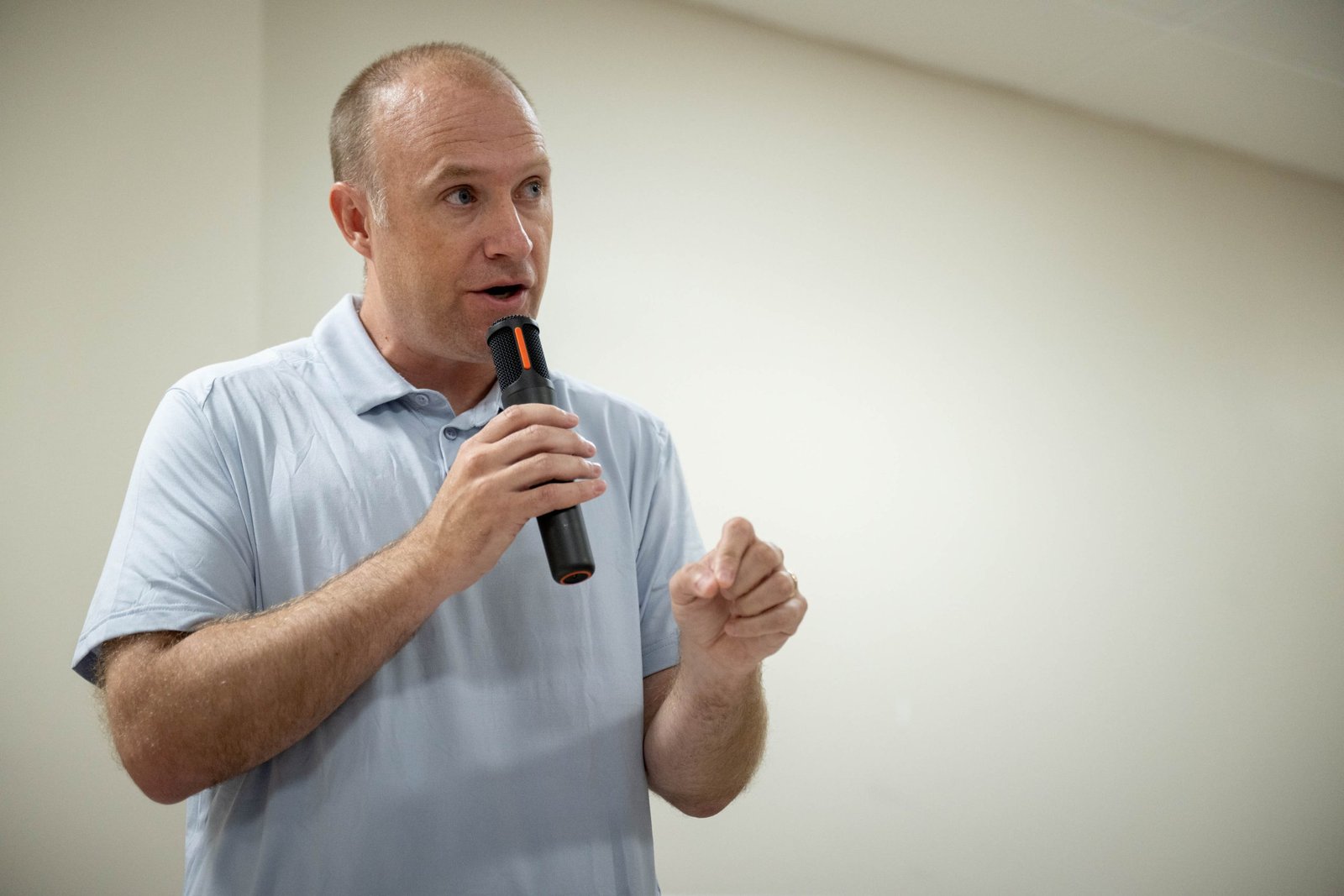
He’s Jake Johnson, whose campaigning prowess and ability to raise campaign cash has caught the attention of the national Democratic Party. Johnson, 42, hopes to unseat Rep. Brad Finstad, the Republican who now holds the 1st District seat.
Related: In a tough election year for House Republicans, Brad Finstad faces a serious challenge from Jake Johnson
But unlike the last time a Democrat unseated a Republican in the district, it has changed and so has American politics.
And while Walz and Johnson share similarities, each man is different.
Both leveraged their years as longtime teachers in the district to broaden their support, among former students and the politically powerful teachers’ unions.
Walz, a history teacher and football coach in Mankato, ran as a moderate Democrat, even as some 1st District voters complain that he became more liberal after winning the governor’s office. Johnson is also running in the district as a centrist.
He is trying to position himself as a fiscal conservative, promising to vote against any legislation that would allow the federal government to borrow more money until Congress balances its budget.
“Members of both parties are not taking this seriously,” he said of the nearly $40 trillion national debt.
But, like most mainstream Democrats, Johnson has also promised to shore up the federal social safety net.
As governor, Walz also focused on expanding social welfare programs, spending his political capital on providing universal school breakfasts and lunches and a generous paid family leave program.
Both men were raised in families that needed the help of social welfare programs.
Johnson, a high school math teacher, grew up in Stewartville with 10 siblings. He says his father collected garbage and his mom went door-to-door reading meters.
The family often needed the help of their church and neighbors and the support of government programs. “I was a SNAP (food stamp) kid,” he said. “We were a Medicaid family.”
Walz also experienced hardship as a youth. After his father died, his mother and younger brother depended on Social Security survivor benefits for support.
‘Red to Blue’
Pat Booker, a voter in the district, watched Walz’s rise and is closely following Johnson’s. She said each of them brought skills from their classrooms to the campaign trail.
“(Johnson) doesn’t hesitate to answer questions and doesn’t hesitate to meet with constituents, and that was the same way with Tim,” she said. “That’s something that Brad absolutely refuses to do.”
She would know, having tried and failed to get facetime with Finstad over the course of eight months. Concerned about SNAP and Medicaid cuts, the New Ulm resident went to Finstad’s local congressional office multiple times per week seeking answers.
“I got one pat letter saying thank you for your concerns,” said Booker, a military veteran and retired probation officer.
There may be a reason Finstad is confident in winning reelection, besides the clear advantages of the makeup of his district and incumbency, which includes heightened name recognition and, usually, greater ability over a challenger to fundraise.
“He’s certainly acting like internal (campaign) polls are telling him he has a wide lead,” said Kevin Parsneau, a political science professor at Minnesota State University in Mankato.
Finstad, 50, lives in New Ulm, a city that holds tight to its German heritage. A statue of the ancient Germanic hero Hermann towers over the city, a glockenspiel chimes every day downtown and August Schell’s brewery holds popular Oktoberfest and Bock Fest events. The German language is conspicuous, adding flavor to the names of bakeries, restaurants and other businesses.
Some locals still trace their lineage to the city’s founding in 1854. There’s even a group known as the Junior Pioneers of New Ulm and Vicinity that celebrates the direct descendants of pioneers who settled in the area by 1870.
In a city steeped so much in history and heritage, though, locals say newcomers can find it hard to shed an “auslander” label, the German word for “outsider.” Booker, who has lived in New Ulm for decades, said the community has become more open minded and welcoming over time.
Yet New Ulm definitely remains a conservative, Republican-majority city. It is the county seat of Brown County, which President Donald Trump handily won over former Vice President Kamala Harris in 2024.
Even so, Johnson has been taking the race to Finstad’s home turf. He walked in New Ulm’s Bavarian Blast festival parade in July and will hold a town hall in the city in August.
An underdog in Trump territory
There’s no doubt Johnson is the underdog in the race.
The district gave Trump 55% of the vote in 2024 and GOP incumbent Finstad has deftly defeated his Democratic challengers since he won a special election for the 1st District seat in 2022.
But Johnson has recently received some vital help from the national Democratic Party.
Mindful of his campaigning skills — which include holding town halls in each of the district’s 21 counties — and especially of his fundraising skills, the Democratic Congressional Campaign Committee (DCCC) has recently placed Johnson on its “Red to Blue” list.
Those on the list are the Democratic candidates who are trying to flip a Republican-held seat and are considered worthy enough of the national Democratic Party’s help.
The “Red to Blue” designation gives candidates access to fundraising support, strategic guidance and training.
Johnson has already proven himself a strong fundraiser, having amassed nearly $1.9 million in campaign funds as of June 30, the latest reports filed with the Federal Election Commission show.
Finstad, meanwhile, has raised nearly $2 million.
Democrats hope Trump’s low approval ratings, an energized Democratic base and the historic advantage the party out of power in the White House holds in midterm elections will allow them to wrest control of the U.S. House from the GOP.
To do that, Democrats need to win in swing districts. They also hope to increase their numbers in the U.S. House by toppling Republican incumbents in places like the 1st District, which the Cook Political Report rates as “likely Republican.”
When Walz flipped the seat, it had been held by Gutknecht, a moderate Republican. Finstad, meanwhile, has closely aligned himself with Trump.
And redistricting, the GOP’s sharp turn to the right and the influence Trump has on local elections has made the 1st District much more difficult territory for Democrats since Walz ran to represent it.
“It’s gotten a lot more conservative,” said Kate Knutson, a political science professor at Gustavus Adolphus College.
Redistricting has a little to do with that. After Census-mandated changes, the district grew even more rural when it picked up new territory in the south of the state along the Mississippi River.
The area has also been impacted by a national trend: rural areas of the United States becoming more Republican as their residents grow concerned that their cultural values – church, family and freedom from government interference – are threatened by a rapidly changing nation.
Social scientists also say that many rural residents also believe that the Democratic Party is composed of urban elites who look down on rural lifestyles and prioritize city or immigrant populations over rural working-class struggles.
Knudson said the “farmer” part of the Democratic-Farmer-Labor Party has “peeled off.”
But she said Johnson might succeed in depressing – at least a little bit – the enthusiasm among farmers for the GOP by continuing to hammer Finstad for embracing Trump policies that have hurt farmers.
“Farmers are frustrated by tariff and immigration sweeps that are hurting the meat packing industry in southern Minnesota,” Knutson said.
Iran’s shutdown of the Strait of Hormuz, which has stalled significant deliveries of oil and fertilizer, raising the cost of farm inputs, has also taken a toll in farm country.
Related: Minnesota progressives campaign on ‘Medicare for All’ as ranks of uninsured grow. Moderates – including Jake Johnson – embrace less ambitious reforms.
Finstad has brushed off criticisms of Trump’s policies on agriculture and has blamed former President Biden for the distress.
“We’re heading in the right direction,” he told MinnPost after a roundtable on veterans’ issues in Mankato in July. “We have come out of some tough times where the inputs have been really crippling for the last six years, and then on top of that we’ve had that stale market because of that lack of trade.”
Speaking to his base
Although Johnson is proving to be a growing threat, Finstad avoids acknowledging his challenger, preferring instead to hold events in the district that can be classified as official business, including meeting with police officers, farm groups and local companies.
“He’s speaking to his base,” Parsneau said. “He does not want to be in an unscripted situation.”
Yet Finstad told MinnPost that “he travels all over southern Minnesota.”
“I’m always listening and communicating with constituents who agree and don’t agree with me,” Finstad said. “I’m having those conversations and I would say reach out to me, reach out to our office. I’m more than willing to have a conversation and answer questions.”
Finstad also said it is “an honor of a lifetime” to serve the 1st District’s 750,000 residents, “but my goal is heaven, not Congress.”
“When November comes, the voters of southern Minnesota will decide, but no one is going to outwork me,” Finstad said.
The post Democrat Jake Johnson, a teacher, tries to solve the difficult math in a red district appeared first on MinnPost.
Leave a Reply