Consider this it’s 1973, and the globe is in a state of chaos. When Arab countries stopped selling oil to the West, prices skyrocketed and were four times higher in a matter of months. Everyday people rush for gas, factories close in Europe, and cars queue up for blocks in America. However, in India, a young country still finding its feet, leaders did more than just hang on; they played a strategic game. They made covert agreements with the Soviet Union, exchanging clothing and agricultural products for inexpensive oil paid in rupees rather than dollars. Indian manufacturing and lights continued to function thanks to this astute trading. Better yet, it absorbed excess Soviet oil that may have disrupted other markets.
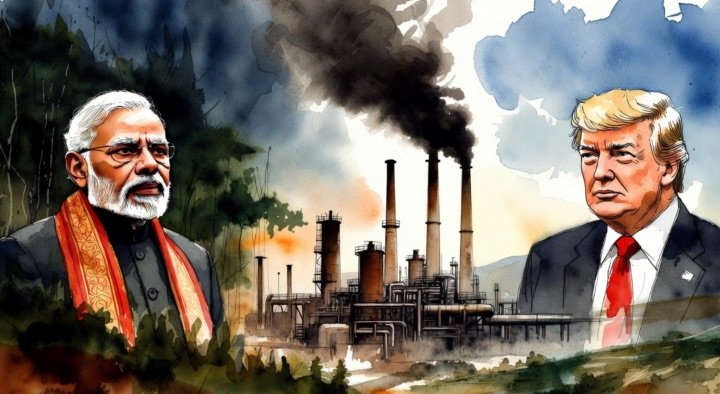
This anecdote, which most people have forgotten, demonstrates India’s early ability to maintain stability throughout difficult times. Fast forward to March 6, 2026 as tensions with Iran escalate, the United States claims to grant India a temporary 30-day waiver to continue purchasing Russian oil. Ships avoid attacks, missiles fly, and the crucial Strait of Hormuz, which handles one-fifth of the world’s oil, appears poised to choke. Experts fear that prices could soar beyond $150 per barrel. This is serious business for India, which purchases 85% of its oil from outside and consumes 5.5 million barrels a day. However, under the steadfast leadership of Prime Minister Narendra Modi, India transforms weakness into strength by employing astute diplomacy and audacious actions to defuse the international crisis once more.
Why does India matter so much here?
It’s easy. The nation is the third-largest oil consumer in the world. By 2030, it might have more thirst than any other location and be at the forefront of growing demand. Because of its influence, India’s decisions have an international impact. A problem with its supplies? Everyone is affected by price increases, from American drivers to African industries. India, meanwhile, is not alarmed. To acquire good deals, it spreads out its purchases and makes use of its scale.
Ranked: The World’s Top 25 Countries by Oil Consumption 🛢️https://t.co/rl8VnwHGd9 pic.twitter.com/nLrQZhA2z9
— Visual Capitalist (@VisualCap) September 16, 2025
This ability shines brightly now and has rescued the day in previous crises. India’s Soviet partnership during the oil shock of the 1970s wasn’t a coincidence. It was signed in 1976 and brought in 5.5 million tons of oil over a four-year period for Indian commodities without the need for dollars. This agreement, linked to the 1971 Indo-Soviet friendship treaty that helped liberate Bangladesh, routed cheap oil through Iraq. It reduced India’s expenditures by half and contributed to the construction of major facilities such as Bombay High. Indira Gandhi’s team pioneered this road of smart independence, but Modi’s government has strengthened it by increasing oil reserves and forging new alliances.
More recent storms, where India’s actions verge on the predictive, vividly echo these historical murmurs. When the US benchmark oil contract (West Texas Intermediate) plummeted to a negative $37 during the 2020 COVID abyss, oil literally paying buyers to take it away, New Delhi didn’t back down; instead, it prospered. In order to reduce the import cost from April to July by 63% to $12.4 billion and strengthen buffers against rebound shocks, refiners chartered 20 supertankers for floating storage, accumulating 40 million barrels at fire sale prices.
This tanker gate windfall filled PM Modi’s fledgling Strategic Petroleum Reserves (SPR), a 5.33 million tonne network at Visakhapatnam, Mangaluru, and Padur facilities, greenlit in 2018 and increased under his watch, granting 74 days of supply in emergencies, exceeding IEA criteria. India coordinated a 5 million barrel release when the IEA tapped global stocks in 2022, a smooth ballet that moderated price increases caused by the conflict in Ukraine without causing domestic pressure. Such foresight is not fortunate. Rather, it is the proactive, uncompromising Modi doctrine, which turns crisis into opportunities and guarantees that India not only survives but also creates peace for a nervous world.
The history of silent leadership is most visible in the Russia-Ukraine conflict, as India’s aggressiveness became the world’s vent. Prior to 2022, Russian crude accounted for only 1% of imports. After the invasion, that number skyrocketed to 40%, with 1.5 million barrels per day at $20 discounts, amounting to approx $166 billion by early Jan 2026. Moscow’s shipments were halted by Western sanctions, but Indian giants such as Reliance’s Jamnagar, the world’s largest refinery, devoured Urals grade and turned it into aviation fuel that ironically powered Europe’s fleets affected by the restrictions, bringing in $6 billion in refined reward. Without this Indian alchemy, as insiders refer to it, Brent could have pierced $200 per barrel and set off a recessionary fire.
Rewriting rules of global #Oil trade: As EU weans from Russian refined product, India becoming de-facto refining hub for Europe, RBC says. India buying record amounts of severely discounted #Russia crude, running its refiners above capacity, & capturing econ rent of crack spreads pic.twitter.com/TDbIBYgmrH
— Holger Zschaepitz (@Schuldensuehner) May 31, 2022
The Iran flare up now brings this story back to life with compelling urgency. Tankers have been redirected due to Israeli retaliation and Tehran’s missile salvos, increasing freight by $4,00,000 per leg and setting the stage for a 3% increase in costs. India’s Gulf lifelines, the Saudi and Iraqi streams, falter, but the US waiver restores Russian taps, a practical reversal of tariff tough negotiations. This action highlights New Delhi’s might and is reminiscent of the Iranian waivers in 2018, when PM Modi obtained six-month exemptions for nine million barrels per month despite Trump-era restrictions.
When it comes to Russia, there is another crucial factor. Despite US tariffs, India had yet to actually ‘stop’ buying Russian crude. The government stated that India imported over 20% of its crude from Russia in February this year, amounting to over 1.04 million bpd.
By 2012, India had successfully negotiated similar nods under previous agreements, combining payments in Rupees to avoid sanctions. India’s 250 million ton refining capacity exports $100 billion a year, supplying 15% of Europe’s aviation fuel and reducing shocks by 10-15% since 2022, despite critics’ murmurs of dependency. This is not opportunism in Modi’s India; it is orchestration, a subtle leaning towards risky investments that pay global returns.
India keeps global oil prices stabilised
Some in Washington and Europe complain that India supports rogue actors by purchasing their energy and even discussing more severe sanctions. However, those thoughts quickly evaporate when they recall connections, such as the US need for cheap Indian pharmaceuticals. Modi’s clear eyed perspective has sculpted it as a gentle reminder of double standards. It is supported by history, India sets the tone rather than following the herd when it comes to epidemic hauls.
India’s influence grows in the future. By 2030, oil consumption might reach 9 million barrels per day, supporting more than one third of global development. Modi’s agenda, which includes $10 billion bets on U.S. shale and more reserve locations like Mangalore, blends fossil fuels with green aspirations like solar agreements. India maintains composure during conflicts like those in Ukraine or Iran, acting as a steady hand on the wheel. India’s calm leadership is not only astute in the volatile world of oil, but it also serves as the glue that keeps prices and lives in check.
Leave a Reply