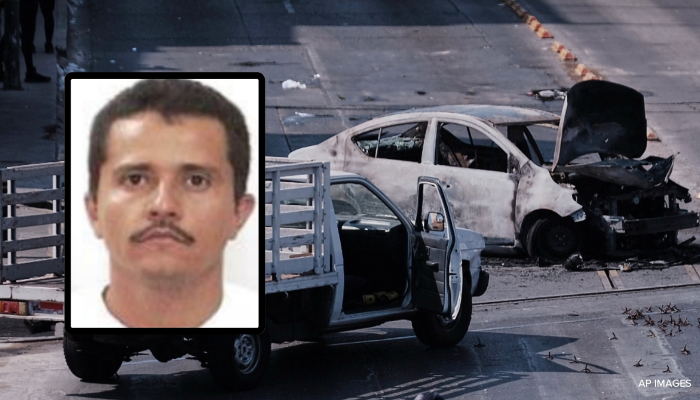
Nemesio Ruben Oseguera Cervantes, popularly known as “El Mencho,” the head of the Jalisco New Generation Cartel (CJNG) was killed in an operation by special forces in western Mexico on 22nd February (Sunday). The action, backed by intelligence from the United States, led to the deaths of 6 other persons as well.
Officials confiscated firearms, rocket launchers and armoured vehicles from cartel members while 2 individuals were placed under arrest. 3 Mexican military personnel also endured wounds. Afterwards, violence broke out in the country which is a part of an extensive history of confrontations between CJNG and the authorities.
The United States had been looking for Oseguera for years, charging that he and CJNG were smuggling large quantities of fentanyl and other drugs into the nation. The State Department even offered a $15,000,000 prize for information that led to his capture.
The latest development unfolded against a backdrop of persistent threats from Washington to Mexico to enhance its anti-drug trafficking initiatives or face a potential US military intervention. The two sides have hailed his death as a victory.
Meet the feared kingpin “El Mencho”
Oseguera or El Mancho, an ex-cop, was born and raised in Michoacan, specifically in Aguililla. He had been heavily involved in drug trafficking since the 1990s. He stayed in California after breaking into the US as an undocumented immigrant in the 1980s and was deported after being nabbed on drug-related charges. Interestingly, he had already experienced his initial run-ins with the law when growing marijuana in his home state.
Oseguera again landed in the United States unlawfully and was once more arrested on similar allegations in 1992. He was found guilty of conspiring to distribute heroin in the nation’s district court for the Northern District of California in 1994 and was sentenced to over three years in jail.
He was then released on parole and deported a second time after which he resumed his criminal activities alongside drug lord Ignacio Coronel Villareal alias “Nacho Coronel.”
El Mencho and Erik Valencia Salazar also known as “El 85” founded the CJNG in 2007 following Villareal’s demise. They were in the Sinaloa Cartel at first but later broke away and the two organisations have been fighting for territory throughout the Latin American nation for years.
Oseguera rose to prominence and had a reputation as a cunning and vicious leader while working with the Milenio Cartel which was situated in his hometown of Michoacan. He was in a prime position when the cartel fractured and turned it into the country’s most powerful criminal outfit. He combined territorial growth and refocused operations into new and profitable illicit ventures.
The fall of the Sinaloa group with the extradition of its leader, Joaquín “El Chapo” Guzman, to the United States also proved advantageous to his leadership and gang. Oseguera soon gained a reputation for threatening officials and enemies in profanity-filled recordings that were posted on social media. Nevertheless, he preferred to stay in the shadows, shrouded in mystery and very few images of him exist.
He operated inside Jalisco with almost complete impunity for years, paying off police and even seeking political safety. His son Ruben Oseguera or “El Menchito,” was convicted regarding narcotics and firearms offences in the United States and given a life term in jail in March 2025. The senior Oseguera had likewise been charged several times in the country prior to his passing.
According to the State Department, he was most recently indicted in April 2022 on counts of conspiracy to produce and distribute cocaine, fentanyl and methamphetamine for importation into the United States, as well as using a handgun during and in connection with narcotics trafficking breaches.
The dreaded Jalisco New Generation Cartel
CJNG, notorious for its ultraviolence and massive military-style arsenal, witnessed a skyrocketing expansion throughout Mexico and established itself in at least 21 of the 32 states with activity in nearly every US state in addition to its global reach. The cartel has more than $20 billion in assets and is mostly based in the west, including the Tierra Caliente region with strongholds in Jalisco, Nayarit and Colima.
The outfit has between 15,000 and 20,000 members and earns billions of dollars a year via illegal mining, forestry drug trafficking, extortion, fuel theft, abduction and migrant smuggling. It is a major distributor of synthetic substances on the continent, including cocaine, methamphetamine and fentanyl.
CJNG used improvised explosive devices and drones to innovate violence. According to Stratfor, it is most violent in Mexico, contributing to the unrest in Guanajuato, Tijuana, Juarez and Mexico City. Its gruesome attacks included the deployment of a rocket-propelled grenade to bring down an army helicopter when an effort was made to catch Oseguera in 2015 along with murdering several politicians, judges, law enforcement and state officials.
The group held public executions that had been widely reported on social media and hung the bodies of their victims from bridges. The persistent aggression is driven by its attempts to increase control. The cartel recruited heavily online and been known for its hits on security officers.
Omar Garcia Harfuch, the current Secretary of Security and Civilian Protection in Mexico, was the target of a 2020 assassination plot. CJNG members with powerful guns, grenades and body armour ambushed him as he was driving to a meeting in an armoured SUV. He survived but two of his bodyguards and a woman were slain.
Similarly, former high-ranking cartel leader Cristian Fernando Gutierrez-Ochoa had been accused of abducting two officers of the Mexican Navy in 2021 in an attempt to free Oseguera’s wife after she was caught by Mexican authorities. She was eventually released in February of last year.
Beheadings and other graphic forms of intimidation were frequently used by the organisation which claimed the lives of two dozen police officers in western Mexico over the course of six weeks in 2015 to threaten the authorities.
According to reports, CJNG used phoney job postings to try to recruit new members, then coerced the gullible candidates into joining the cartel. Those who attempted to resist or flee have been tortured or executed. A team searching for missing family members discovered burnt bones, shoes and clothing in a suspected CJNG training ground in March.
Aftermath of “El Mencho’s” death
Several regions of Mexico have been paralysed following the outbreak of violence after news of Oseguera’s death circulated. Meanwhile, countries including the United States, Canada and India have issued advisories to their nationals residing there and some flights have been cancelled in response to the critical situation.
Leave a Reply