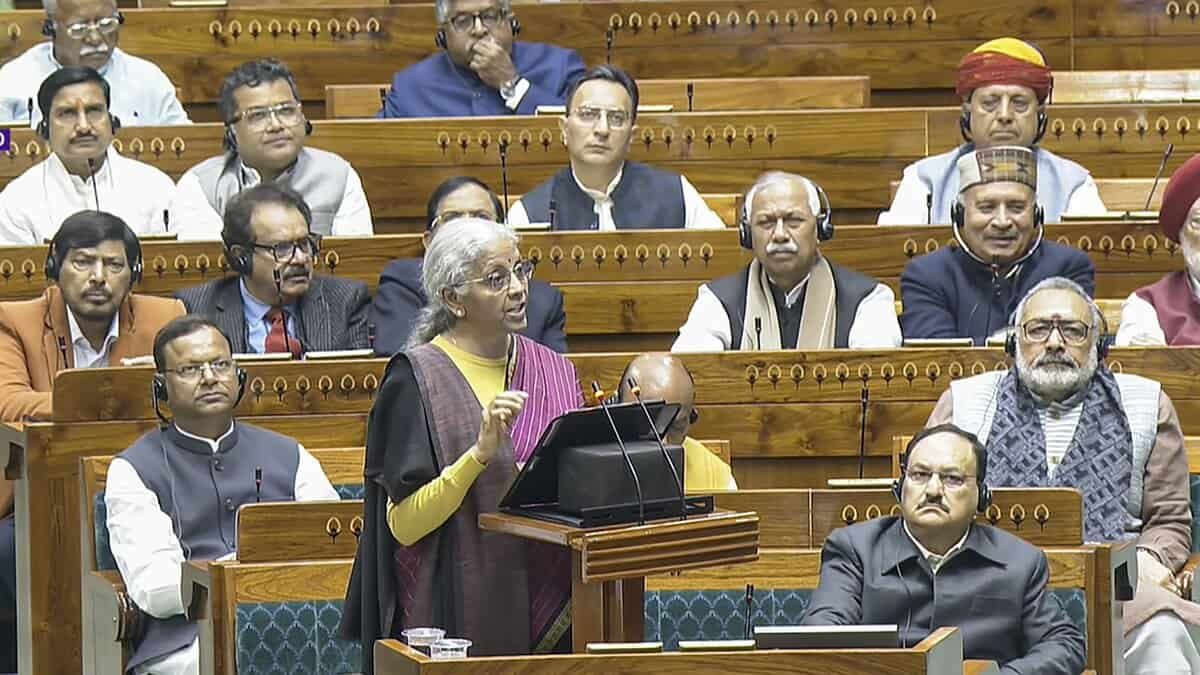
Finance Minister Nirmala Sitharaman on Sunday said the Union Budget 2026–27 prioritises delivery of reforms over rhetoric and is a “yuva shakti–driven budget”, aimed at sustaining high growth, generating employment and fulfilling aspirations amid global uncertainty.
Presenting the Budget in the Lok Sabha, Sitharaman said India’s economic trajectory over the past 12 years has been marked by stability, fiscal discipline, sustained growth and moderate inflation despite geopolitical disruptions.
“This is the result of conscious choices we have made in times of uncertainty,” she said, adding that the government has pursued far-reaching structural reforms, fiscal prudence and monetary stability while maintaining a strong thrust on public investment.

She said Aatmanirbharta remains a “lodestar” of policy, with emphasis on domestic manufacturing, energy security, reduced import dependence and citizen-centric growth.
Fiscal consolidation and federal finances
Sitharaman said the government remains firmly committed to fiscal prudence and debt consolidation.
Fiscal deficit
- FY26: 4.4% of GDP
- FY27: 4.3% of GDP
- Total expenditure FY27: ₹53.5 lakh crore (₹49.6 lakh crore in FY26)
- Capital expenditure FY27: ₹12.2 lakh crore
- Net market borrowing: ₹11.7 lakh crore
- Gross market borrowing: ₹17.2 lakh crore
- Net tax receipts: ₹28.7 lakh crore
- Debt-to-GDP ratio: 55.6% in FY27
She said the government has accepted the 16th Finance Commission’s recommendation to retain 41 per cent tax devolution to states, the highest ever, with Rs 1.4 lakh crore to be transferred to states in FY27.

Infrastructure, investment and industrial corridors
Apart from raising capital expenditure, the Budget announced multiple measures to crowd in private investment and recycle public assets:
- Infrastructure Risk Guarantee Fund
- Dedicated REITs for CPSE asset recycling
- Incentives of ₹100 crore for large municipal bond issuances
- Integrated East Coast Industrial Corridor, with a well-connected node at Durgapur
- Provision for 4,000 electric buses
- Removal of customs duty exemptions on items manufactured domestically or with negligible imports
- Extension of exemption on capital goods used for manufacturing lithium-ion cells for battery storage
- ₹20,000 crore over five years for Carbon Capture, Utilisation and Storage (CCUS)
Manufacturing, MSMEs and exports
To strengthen domestic manufacturing and export competitiveness, the Budget provides for:
- India Semiconductor Mission 2.0, with an outlay of ₹40,000 crore
- Electronics manufacturing outlay raised to ₹40,000 crore
- Three dedicated chemical parks
- Support for critical mineral facilities in Odisha, Kerala, Andhra Pradesh and Tamil Nadu
- Revival of 200 legacy industrial clusters
- Creation of champion MSMEs
- SME Growth Fund of ₹10,000 crore
- Self Reliance India Fund top-up of ₹4,000 crore
- Biopharma SHAKTI with ₹10,000 crore over five years
- Mega textile parks and an integrated textile programme
Schemes for container manufacturing, capital goods and construction equipment
To boost exports, Sitharaman announced:
- Duty-free import limit for inputs used in seafood processing for exports raised from 1% to 3% of the FOB value
- Extension of the duty-free import facility from footwear exports to exports of shoe uppers
Transport, railways and waterways
Highlighting sustainable logistics, the Finance Minister announced:
- Dedicated Freight Corridor connecting Dankuni and Surat
- Seven high-speed rail corridors as growth connectors
- 20 new national waterways over five years
- Ship-repair ecosystem for inland waterways at Varanasi and Patna
- Coastal cargo scheme
- Incentives for indigenous seaplane manufacturing
Services, education and yuva shakti
Elaborating on the second kartavya, Sitharaman said close to 25 crore people have exited multidimensional poverty, and the next phase will focus on aspiration-led growth.
Key measures include:
- Education to Employment and Enterprise Standing Committee
- Services sector positioned as a core driver of Viksit Bharat
- Target of 10% global services share by 2047
- Assessment of AI and emerging technologies on jobs and skills
Calling the Budget “yuva shakti–driven”, she said education, skills and services-led employment will anchor India’s growth strategy.
Higher education, design and creative economy
The Budget announced a major push to education and the creative industries:
- Indian Institute of Creative Technologies, Mumbai, for animation, VFX and gaming
- AVGC content creator labs in 15,000 schools and 500 colleges
- Five university townships and academic zones with colleges, skill centres and residential facilities
- One girls’ hostel in every district
- New National Institute of Design in East India
- Tourism, culture and hospitality
Sitharaman said tourism will play a key role in employment generation and local economic expansion.
Announcements include:
- National Destination Digital Knowledge Grid to digitally document all places of cultural and spiritual significance
- Development of 15 archaeological sites — including Lothal, Dholavira, Rakhigarhi, Sarnath, Hastinapur and Leh Palace — as experiential cultural destinations
- Opening excavated landscapes to the public through curated walkways and immersive storytelling
- Pilot scheme to upskill 10,000 tourist guides at 20 iconic sites via a 12-week hybrid programme with an IIM
- National Institute of Hospitality, by upgrading the National Council for Hotel Management and Catering Technology
- Development of ecologically sustainable mountain trails in Himachal Pradesh, Uttarakhand, Jammu & Kashmir, Araku Valley and the Western Ghats
- Creation of five tourism destinations in five Purvodaya states
Health and social infrastructure
The Finance Minister announced:
- 50% capacity expansion in district hospitals through emergency and trauma care centres
- Three new All India Institutes of Ayurveda
- Upgradation of AYUSH pharmacies and drug testing labs
- Upgrade of the WHO Global Traditional Medicine Centre, Jamnagar
- Five regional medical tourism hubs
- Network of 1,000+ accredited clinical trial sites
- Agriculture, plantations and AI
The Budget provides for:
- Bharat Vistar, a multilingual AI platform integrating agri-stack portals and ICAR practices
- Coconut promotion scheme to replace non-productive trees
- Dedicated programmes for cashew and cocoa to build premium global brands by 2030
- Revival of the sandalwood ecosystem
Sports, youth and community initiatives
Sitharaman announced:
- Khelo India Mission to transform the sports sector over the next decade
- Development of sports goods manufacturing and research
- She Marts as community-owned retail outlets
- Mahatma Gandhi Gram Swaraj initiative to strengthen khadi and handloom
Taxation, IT reforms and compliance
On taxation, Sitharaman announced sweeping simplification:
- Income Tax Act, 2025, to come into force from April 1
- Law is revenue-neutral, with 50% reduction in text and sections
- Introduction of a single “tax year”, removingthe assessment year–previous year distinction
- Simplified rules and redesigned forms
- TDS refunds are allowed even for delayed returns without penalty
- Six-month foreign asset disclosure scheme for small taxpayers, students, tech professionals and relocated NRIs
- Revised return filing deadline extended to March 31 with a nominal fee
Staggered ITR timelines:
- ITR-1 and ITR-2: July 31
- Non-audit business cases and trusts: August 31
- Returns can be updated even after reassessment with 10% tax
- No interest liability on the penalty amount during the appeal period
- MACT interest is exempt from income tax
- STT on commodity futures raised to 0.05%
- MAT made the final tax rate reduced to 14%
- Joint panel of MCA and CBDT for income computation and disclosure standards
Data centres and IT services
To position India as a global digital hub, Sitharaman announced:
- Tax holiday till 2047 for foreign companies setting up data centres in India for global operations
- Safe harbour of 15% on cost for companies providing data services from India to related entities
- All IT services to be clubbed under a single category
- Common safe harbour margin of 15.5%
- Safe harbour threshold raised from ₹300 crore to ₹2,000 crore
- Safe harbour approvals to be done through an automatic rule-based model
Banking and capital markets
The Finance Minister announced:
- High-level committee on Banking for Viksit Bharat
- Restructuring of REC Ltd and PFC
- Review of FEMA non-debt rules
- Market-making framework for corporate bond indices
- Increase in PIO investment limit from 5% to 10%
Three kartavyas and outlook
Sitharaman said the Budget is anchored around three kartavyas — accelerating growth, fulfilling aspirations and ensuring inclusion.
“India will continue to take confident steps towards Viksit Bharat, balancing ambition with inclusion,” she said.
The Finance Minister presented the 15th Budget of the Modi government and her ninth consecutive Budget, becoming the first woman Finance Minister to do so.
(This story will be updated as new inputs emerge)
Leave a Reply