










During Putin’s visit, India will likely push for deeper cooperation on small reactor technology.
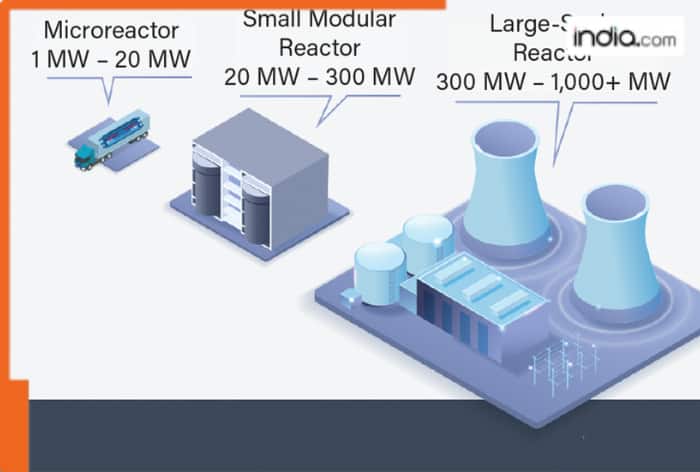
India just announced something big in the Union Budget 2025. Finance Minister Nirmala Sitharaman unveiled a ₹20,000-crore Nuclear Energy Mission to develop Small Modular Reactors, or SMRs as they’re called. The government wants at least five Indian-made SMRs running by 2033. This might sound like just another government scheme, but it’s actually a game-changer for our country’s energy future, and it’s directly connected to Russian President Vladimir Putin’s upcoming visit to India.
Let me explain why this matters to you and me. Right now, the world gets 82% of its energy from fossil fuels like coal, oil and natural gas. These fuels are slowly destroying our planet through pollution and climate change. Everyone talks about solar panels and wind turbines as the solution, but here’s the catch: they only work when the sun shines or the wind blows. What happens at night? What happens when there’s no wind? We still need electricity 24×7, don’t we? This is where nuclear power becomes crucial. Unlike solar or wind, nuclear reactors work round the clock, in any weather, producing clean electricity without releasing carbon dioxide into the atmosphere.
But traditional nuclear power plants have their own problems. They’re massive, incredibly expensive, take 10 to 15 years to build, and if something goes wrong, the consequences can be catastrophic. Remember Chernobyl or Fukushima? That’s why the world is now excited about Small Modular Reactors. These are like the smartphone version of nuclear reactors compared to the old landline telephones. They’re small, producing only 30 to 300 megawatts of electricity per unit, while regular nuclear plants produce 500 MW or more. More importantly, these reactors have a modular design, meaning their parts can be manufactured in factories and assembled on-site, just like building with LEGO blocks. This makes them faster to build, cheaper, and much safer.
Think about Bengaluru, our tech capital. The city currently needs 157 million units of electricity per day, which translates to about 6,542 MW of average power demand. That’s the electricity requirement for just one city. Now multiply that across India’s growing cities and industries. The International Atomic Energy Agency says the world must more than double its nuclear energy by 2050 to have any real chance of reaching net-zero carbon emissions. India cannot afford to miss this opportunity.
Here’s where Russia enters the picture. Only two small modular reactor projects in the entire world are actually working right now. One is Russia’s Akademik Lomonosov, a floating nuclear power plant that started operating in May 2020. It sits on a ship-like platform with two small reactors producing 35 MW each. The second is China’s HTR-PM, which started commercial operations in December 2023. Russia has decades of experience with nuclear technology and has already proven that these compact reactors can work in real-world conditions. India has been Russia’s trusted partner in nuclear energy for years, with Russian help building the Kudankulam nuclear plant in Tamil Nadu.
During Putin’s visit, India will likely push for deeper cooperation on small reactor technology. Why the urgency? Because India is calling its program “Bharat Small Modular Reactors” and wants to become a world leader in this technology. It’s not just about generating electricity at home. If India can master this technology with Russian partnership, it can export it to other developing countries facing similar energy challenges. This becomes a powerful tool in foreign policy, helping India increase its global influence while also supporting its clean energy goals.
The government is also changing two important laws, the Atomic Energy Act and the Civil Liability for Nuclear Damage Act, to allow private companies to participate in nuclear power generation. This means more investment, faster development, and quicker deployment of these small reactors across the country. They can be installed on old thermal power plant sites, using the infrastructure that already exists. No new land acquisition, no displacing people from their homes, just smart reuse of what we already have.
Safety is another crucial advantage. Small modular reactors are designed with passive safety features that work automatically without electricity or human intervention. They use natural forces like gravity and air flow to keep the reactor safe, even during emergencies. They produce less nuclear waste than large plants and have stronger earthquake protection. Studies show they can be safely built in many locations that wouldn’t qualify for traditional nuclear projects.
The global demand for clean energy is exploding. By 2050, electricity use in our daily lives is expected to increase by 80 to 150%. The minerals needed for making solar panels and batteries, like lithium and cobalt, are expected to see demand increase by 3.5 times by 2030. Three countries control 50 to 100% of these mineral supplies, creating serious geopolitical risks. India needs to diversify its clean energy options, and small nuclear reactors offer that alternative.
Putin’s visit isn’t just about diplomatic photo opportunities. It’s about securing India’s energy independence, fighting climate change, creating high-skill jobs in technology and manufacturing, and positioning India as a global leader in next-generation nuclear technology. The ₹20,000-crore mission is our ticket to that future, and Russia holds the key to making it happen faster. The decisions made during this visit could literally power India’s growth for the next fifty years.
—–– E.O.M
(Girish Linganna is an award-winning science communicator and a Defence, Aerospace & Geopolitical Analyst. He is the Managing Director of ADD Engineering Components India Pvt. Ltd., a subsidiary of ADD Engineering GmbH, Germany.)